
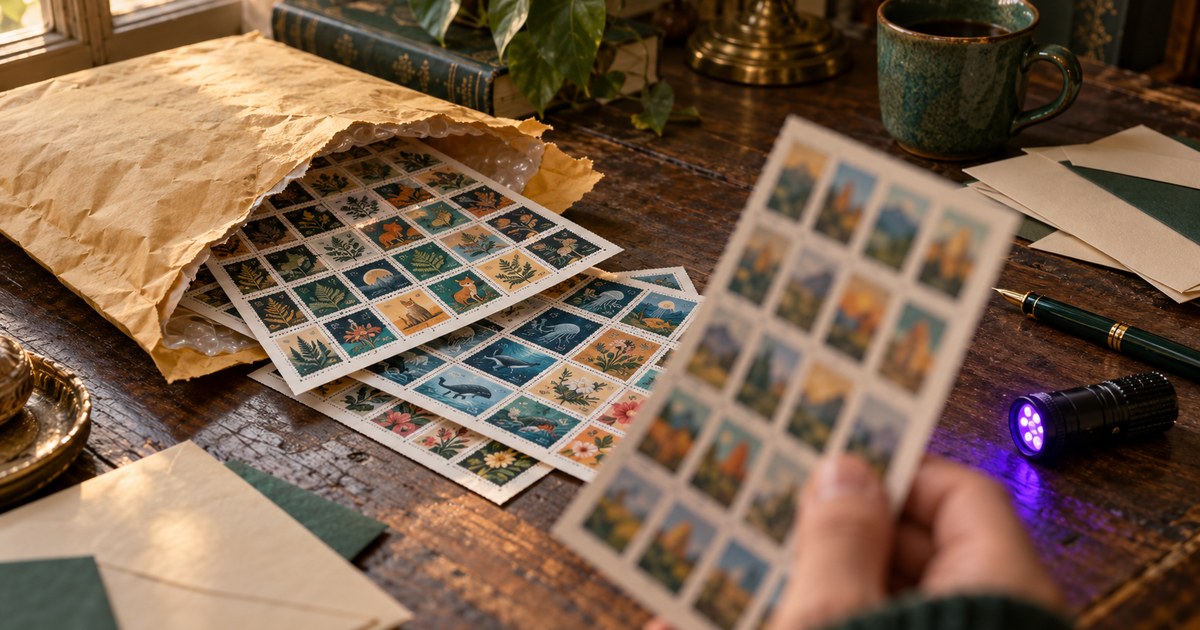
A roll of Forever stamps at 40 percent off looks like a bargain, especially in the weeks before holiday cards go out. It is usually the opposite. Counterfeit Forever stamps have become common enough that the Postal Inspection Service now runs a dedicated reporting channel for them, and the stamps that look cheapest online are the ones most likely to be fake.
Counterfeit Forever stamps are fakes printed to look like real postage and sold mostly online, typically in bulk at a discount of 20 to 50 percent, the Postal Inspection Service says. The price is the strongest tell. Blurry print, the wrong paper and missing security features confirm it, and mail carrying fakes can be treated as abandoned and disposed of.
Here is how to check stamps you already bought, what happens if you have used them, and why the Forever stamps sitting in an old desk drawer are almost certainly fine.
How common are counterfeit Forever stamps?
Common enough to change postal rules. In a 2024 AARP report, Jay Bigalke, editor in chief of Linn’s Stamp News, said he had catalogued about 750 different Forever stamp counterfeits in 2023, most of them made in the previous ten years, and had identified at least 200 more since. He said counterfeiting of Forever stamps grew sharply in 2021, and that flag stamps are the designs copied most often, with many commemoratives copied too.
The Postal Service responded in 2023. A final rule published in the Federal Register on April 11, 2023 changed the Domestic Mail Manual so that mail bearing counterfeit postage will be considered abandoned and disposed of at the Postal Service’s discretion, effective May 7, 2023. The Postal Service said at the time that customers whose mail is lost this way must seek recourse from whoever sold them the postage.
The price test: the one check that catches most fakes
The Postal Service does not sell stamps below face value, and the Postal Inspection Service says legitimate retailers may offer only very small discounts under resale agreements with USPS. Counterfeits, by contrast, are often sold in bulk at a significant discount, anywhere from 20 to 50 percent, which the Inspection Service calls a telltale sign.
Its list of warning signs reads like a description of most cheap listings:
- deep discounts, especially on bulk lots;
- sellers on social media, third-party marketplaces or unfamiliar websites;
- vendors based outside the United States;
- sellers who are not Approved Postal Providers.
Since July 12, 2026 a Forever stamp mails a one-ounce letter for 82 cents, which is what it is worth as postage whatever you paid. A coil of 100 offered at 45 or 50 dollars is asking you to believe someone is selling postage at a loss. Our guide to Forever stamp value explains why genuine stamps essentially never trade above face, and why genuine resellers who buy them pay below it.
Physical checks you can do at the kitchen table
If the stamps are already in your hands, compare them against a pane you know is genuine, bought at a post office counter. Mystic Stamp Company’s description of a counterfeit set of 2012 flag stamps is a good field guide, because it lists the differences one by one:
- Print quality. Genuine stamps are printed with solid, sharp inking. The counterfeit shows dot-matrix, fuzzy printing. Under a simple magnifier, look at fine lines, small lettering and the edges of colour areas.
- Microprinting. Modern US stamps carry tiny “USPS” lettering worked into the design as a security feature. On the genuine flags it is sharp and readable; on the counterfeit it is illegible.
- Paper. The originals use thinner, more flexible paper; the fakes are thick and stiff. The counterfeit paper is also bright white where the genuine paper is dull.
- Tagging. Genuine stamps are tagged with a phosphor coating that postal machines detect. The counterfeit flags have none. A shortwave ultraviolet lamp shows tagging on genuine stamps, but treat this as one clue rather than proof, since tagging varies by issue.
- Separation and layout. The fakes do not peel apart cleanly, and they lack the plate numbers found on genuine panes.
AARP’s report adds two more signs: a USPS comparison photo shows counterfeit colours darker and duller than the genuine stamp, and Bigalke mentions a foul, plastic smell that he attributes to cheap ink.
Be honest about the limits of all this. Bigalke told AARP that telling real from fake is difficult without expert knowledge, and a Postal Inspection Service spokesman said there had been an increase in high-quality counterfeits made overseas. According to the same report, counterfeiters have even copied the coding that postage-cancelling machines read. A pane that passes every check above is probably genuine, not certainly genuine. The check that settles the question is where it came from.
What happens if you already used them?
The rule since 2023 is blunt: mail with counterfeit postage can be treated as abandoned and disposed of at the Postal Service’s discretion. That is different from mail with no stamp at all, which is still normally returned to the sender, because the Postal Service treats a missing stamp as a possible honest mistake and counterfeit postage as an attempt to defraud it.
The Postal Inspection Service says it is illegal to buy or use counterfeit postage, and that using it can result in action by the Inspection Service. If you bought fakes without knowing, the practical steps are:
- Stop using them. Do not put them on anything you need delivered.
- Do not resell them. Passing them on, even at the price you paid, puts someone else in the same position.
- Report the seller. The Inspection Service takes reports through its Counterfeit Postage Reporting System at report.uspis.gov, and general reports at uspis.gov.
- Go back to the seller or the platform. As the Postal Service itself said, your recourse is against the vendor, so marketplace buyer protection is the realistic route to your money.
Collectors do keep known counterfeits in albums, labelled as such, beside the genuine stamp. Dealers sell them that way. That is a hobby use, not a postage use, and it changes nothing about whether they can go on mail.
Are the old Forever stamps in your drawer fake?
Almost certainly not. The counterfeit flood is a recent, online phenomenon, and the Inspection Service ties it to discounted bulk sales through social media and marketplaces. Stamps bought at a post office, from the USPS online store, or from a retailer that sells postage as an Approved Postal Provider are genuine. A half-used book of Forever stamps from a relative’s desk, bought at the post office a decade ago, is worth exactly what any other Forever stamp is worth: one letter’s postage at today’s rate.
The stamps worth a second look are the ones that arrived in a padded envelope after a too-good online order, usually in large quantities of a single flag design.
How to buy Forever stamps safely
The Postal Inspection Service points buyers to the USPS online store and to Approved Postal Providers, which can include big-box and warehouse retailers, and a post office counter is the other obvious source. If an online listing is not one of these and is cheaper than face value, the discount is the warning.
If you are sorting a whole box of mixed postage rather than buying new, the questions change: which stamps are still valid, which are worth more than face, and which are simply useful for mailing. Our guide on what to do with old stamps ranks the options, and where to sell old stamps covers the buyers if you decide to sell anything that is genuinely collectible.
Checking older stamps in the same box
Counterfeit postage is mostly a modern problem, but inherited boxes often mix new Forever stamps with decades of older issues. For those, the question is identification rather than authenticity, and the order you check things in matters, which we walk through in how to identify a stamp. A photo of the stamp in Stampo is a fast first pass: it reads the design, names the issue and its catalogue number, and gives an honest value range, so you can set aside the ordinary postage and spend your attention on anything that deserves it. For a suspected counterfeit, the app is a starting point, and the seller and the Postal Inspection Service are where the matter is settled.
Sources
- Counterfeit Postage - U.S. Postal Inspection Service
- Beware: Criminals Sell Counterfeit Postage Stamps Online - AARP (updated 2024)
- USPS Warns the Public About Surge in Use of Counterfeit Postage (2023) - United States Postal Service
- Final rule: Counterfeit Postage, 88 FR 21478 (April 11, 2023) - Federal Register via GovInfo
- 2012 Counterfeit U.S. Flags: Equality, Justice, Freedom and Liberty - Mystic Stamp Company
- What is an Approved Postal Provider? - USPS FAQ
- U.S. Postal Service Recommends New Prices for July (2026) - United States Postal Service