
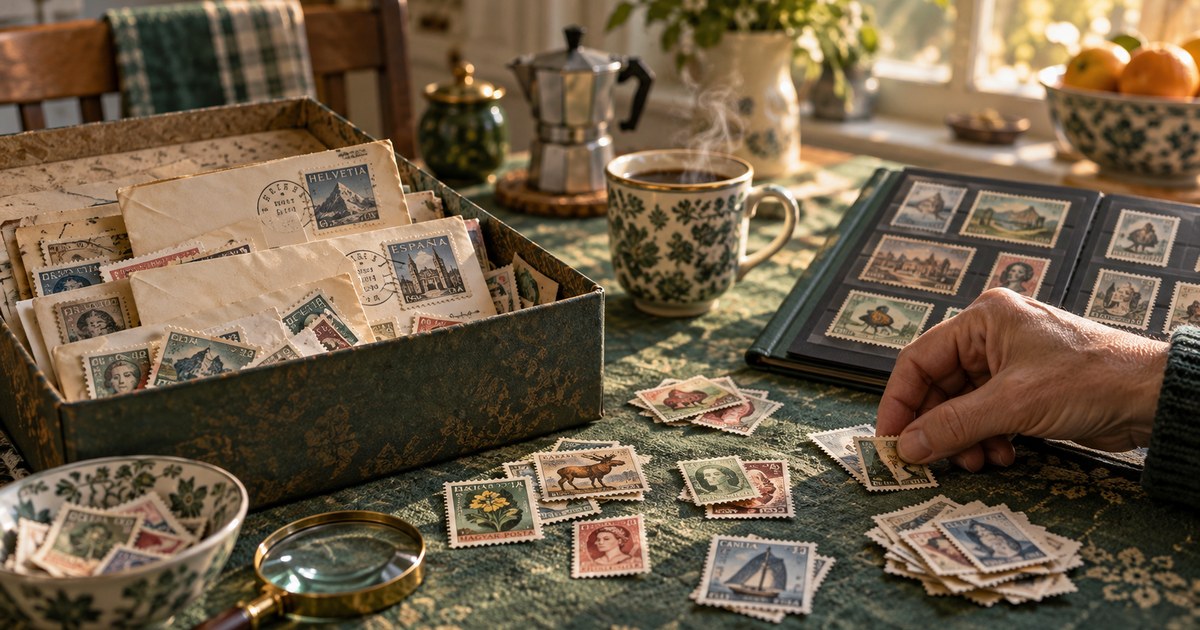
A box of old stamps has a way of sitting untouched for years, because every option in front of you feels either irreversible or like too much work for an unknown payoff. Selling assumes you know what you have. Throwing them out feels wasteful even when they probably are worthless. Meanwhile the box just sits there, and the question people actually type is not “where do I sell these” but the more honest one: what to do with old stamps in the first place.
There are six realistic options: sell them, spend the unused ones as postage, donate the collection, keep and organise it properly, gift it to a young collector, or discard the genuinely worthless remainder. Which one fits depends on what you find during a rough identification pass, not on which option sounds most appealing before you look.
That identification pass is the step every guide to decluttering skips, and skipping it is how people accidentally throw away the one interesting item in the box.
Why the order matters more than the list
Six options sound like six equally good doors. They are not. Two of them, selling and discarding, are irreversible: once a stamp is gone, it is gone. Two more, spending as postage and donating, give away value you might not know you had. Only keeping the collection intact preserves every option for later. So the sequence that protects you is: find out roughly what you have, then choose.
A rough pass takes far less time than people expect. Photograph anything that looks pre-1940, anything with a colour, denomination, or design you have not seen before, and anything still attached to an envelope, then set the obviously modern, heavily used bulk aside. Identifying a stamp walks through the checks in the right order, and photographing with Stampo does the same pass in seconds per stamp rather than minutes. Only after that pass do the six options below actually apply to the right pile.
Option 1: sell what has real value
If the pass turned up pre-1940 material, mint stamps with original gum, covers, or anything you cannot immediately place, selling is usually the right first option for that pile specifically, not for the whole box. Where you sell it, and how much of it you sell yourself versus through a dealer or auction house, is a separate decision with its own trade-offs, which where to sell old stamps covers channel by channel. This option answers “I have decided to sell, where do I go.” The question here is narrower: should you sell at all, or is one of the other five options actually the better fit for this particular pile.
Option 2: spend unused stamps as postage
For a stack of unused stamps with no real collector interest, this is the option people forget exists. A stamp is, before anything else, a prepaid piece of postage, and using it that way is not a downgrade, it is the stamp doing its original job.
The general pattern is that older unused stamps often remain valid, but the exact rule is set by each country’s postal service and it genuinely varies, so treat this as a pattern to check rather than a universal fact. In the United States, stamps issued from 1861 onward have never been demonetized and remain valid postage indefinitely, according to Wikipedia’s account of the country’s postage stamp demonetization policy. In the United Kingdom the rule is stricter and has recently tightened: Royal Mail’s everyday definitive stamps without a barcode stopped being accepted as postage after 31 July 2023, as the Association of British Philatelic Societies reported, though Royal Mail’s Swap Out scheme still exchanges old non-barcoded stamps for valid ones free of charge, with no announced closing date. So a drawer of unused pre-2023 British definitives is not worthless, but it needs converting through the Swap Out form rather than sticking straight onto an envelope. Check your own country’s postal service for its equivalent rule before assuming either pattern applies to you.
Option 3: donate the collection
Donating suits stamps that have modest hobby value but no real market value, where you would rather see them used than sold for a few pounds or dollars. Stamps for the Wounded, a nonprofit that has supplied stamps and philatelic supplies to hospitalized and disabled veterans since 1942, accepts mint and used stamps, whole albums, and philatelic supplies as donations. It is a genuine outlet for exactly the kind of common, well-organised accumulation that a dealer would offer very little for. This option, like spending stamps as postage, gives away value, so it belongs after the identification pass has already ruled out anything scarce, not before.
Option 4: keep and organise it properly
If the collection has sentimental weight, or you are simply not ready to part with any of it, keeping it is entirely reasonable, provided you protect it while you decide. The two things that matter are storage conditions and structure: acid-free stockbooks or albums with proper mounts, kept somewhere cool and dry, away from the everyday damage that quietly destroys value over years. How to store a stamp collection covers the materials and the mistakes to avoid. Keeping the collection intact is also the only one of these six options that costs you nothing irreversible, which makes it the default while you are still deciding among the others.
Option 5: gift it to a young collector
A starter collection is a genuinely good gift for a child who shows any interest, and it solves a problem the hobby has: new collectors need a reason to start. The American Philatelic Society runs Youth in Philately programmes, including a virtual youth stamp club, specifically to give young people a way into the hobby, which is a sign there is real demand for exactly this kind of gift on the receiving end. This suits the common, colourful, easy-to-sort material that fills most inherited boxes: modern commemoratives and worldwide packet mixtures are more fun to page through than they are to sell.
Option 6: discard the genuinely worthless remainder
After the other five options have taken their share, some material is left over that is neither sellable, spendable, donatable, worth keeping, nor of interest to a young collector: damaged, waterlogged, mouldy, or duplicate common stamps beyond any reasonable use. Discarding those is fine, and it is the only option on this list where getting it wrong costs you nothing, precisely because everything with any real interest has already been pulled out by this point.
The mistakes that cannot be undone
Whichever option you are heading toward, avoid these before you get there, because none of them can be reversed:
- Soaking stamps off covers. An envelope with its postmarks and routing intact can be worth more than the stamp on it, a point the American Philatelic Society’s own estate guidance makes to heirs directly. Soaking destroys that context permanently, and how to remove stamps from envelopes covers the narrow cases where separating them is actually the right call.
- Trimming perforations. A stamp’s perforations are part of what identifies its exact catalogue listing. Trimming them to fit a mount or “tidy up” an edge can turn a stamp into an unidentifiable one.
- Pasting stamps into a scrapbook. Glue and adhesive tape are permanent and acidic, and a pasted stamp cannot be safely removed later without damaging it further.
- Breaking up a collection that is worth more whole. A complete run, a themed set, or an album a collector deliberately assembled can carry a premium for completeness that individual stamps sold piecemeal lose entirely. Warwick & Warwick’s appraisal guidance makes the same point from the trade side: a collection is often worth more as one lot to the right buyer than as a pile of loose singles.
The one step before any of the six
None of these six options is wrong. The mistake is picking one before you know which pile you are actually holding. An hour with a camera, working through the checks in how to identify a stamp or letting Stampo do the same pass automatically, tells you which stamps belong in the sell pile, which are genuinely fine to spend or give away, and which deserve nothing more exciting than a stockbook shelf. If you have just inherited the box rather than found it in a drawer, the first five steps for an inherited collection cover the same triage in more detail, including when it is worth paying for a proper appraisal before choosing anything on this list.
The honest expectation, for almost every box: most of it sorts into option two, four, or six, quickly and without regret. The point of doing the pass first is making sure the small exception, if one exists, does not end up in the same pile as everything else.
Sources
- Postage stamp demonetization - Wikipedia
- Royal Mail Reminds Customers to Use Up or Swap Out Non-Barcoded Definitive Stamps - ABPS
- Stamps for the Wounded
- Youth in Philately - American Philatelic Society
- Disposing of a Collection: a guide for the collector in estate planning - American Philatelic Society
- How to appraise stamps - Warwick & Warwick