Somebody has left you a shoebox, a carrier bag of envelopes, or six albums with handwriting in them, and your instinct is to tidy it up before you decide what to do. That instinct is right, but the details matter more than they look. Knowing how to organize a stamp collection is largely a question of which moves are reversible, since a weekend of enthusiastic sorting can permanently remove value that took decades to accumulate.
Sort by country first, then by date or catalogue number within each country, because that is how catalogues, dealers, and auction lots are structured. Use stockbooks or acid-free pages, never hinges on mint stamps and never self-adhesive album pages. Leave covers, complete sets, and any existing album arrangement intact, and write your inventory at album level rather than stamp level.
Most guides on this subject are written to onboard new hobbyists, so they talk about choosing a theme you love. That is not your situation. You did not choose this collection, you are probably going to sell or divide it, and the question worth answering is not which arrangement is most enjoyable, it is which arrangement a buyer will actually pay more for.
Which organising scheme protects resale value?
There are three common schemes, and they are not equally good for someone who may sell.
By country, then by date within country. This is the scheme that matches how the world’s stamp catalogues are built. Scott, Stanley Gibbons, Michel, and Yvert et Tellier all sort by country of issue first, then by issue date inside each country. A collection arranged the same way can be checked against a catalogue page by page, and a dealer who specialises in one region can see instantly what you have. This is the default, and for resale it is the right one.
By year across all countries. Visually satisfying and occasionally useful for a single-country collection, but for a mixed worldwide accumulation it fights the catalogue at every step and makes valuation slower.
By topic. Topical collecting, arranging stamps by subject such as birds, ships, or space, is a legitimate and popular branch of the hobby. It is also the worst possible scheme to impose on an inherited collection you intend to sell, because it scatters complete sets across a dozen sections and hides the country groupings a buyer needs. Sorting a country collection into topics is easy to do and genuinely painful to undo.
How to organize a stamp collection that arrived as a shoebox
A first pass, in the order that keeps your options open:
- Change nothing chemical. No water, no soaking, no peeling stamps off paper, no cleaning of any kind. Every one of those is irreversible and several of them are actively destructive.
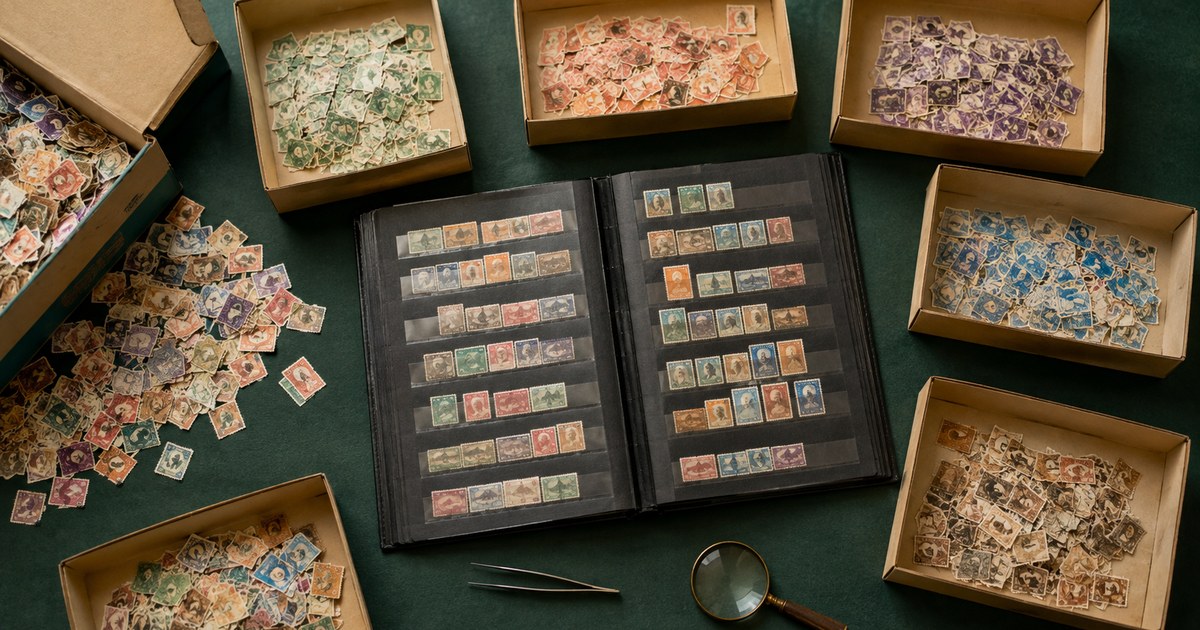
- Triage into four piles before sorting anything. Stamps still on envelopes or paper, loose used stamps, loose unused stamps with gum on the back, and anything that is not a stamp (revenue labels, first day covers, postcards, loose album pages). Handle the unused pile by the edges or with tongs.
- Sort the loose piles by country. Plain envelopes or glassine sleeves labelled with a country name are the standard waypoint. Treat them as a waypoint and not a destination, because an APS-published three-year ageing test found glassine envelopes yellowed, stained, and turned brittle, with gummed stamps fusing to them.
- Sort within each country by rough era, then denomination. You do not need catalogue numbers yet. Nineteenth century, early twentieth, modern is enough granularity for a first pass.
- Move each country into its own stockbook section. Stamps slide into stockbook strips without adhesive of any kind, which is what makes them the correct home for a collection you are still working through.
- Write an album-level inventory, not a stamp-level one. Guidance published by the American Philatelic Society is explicit that listing every stamp you own is too much information, while a line reading “one Scott US album” is too little. List each album, binder, and stockbook with a short description of what is in it, and note anything that looks unusual.
Store the results upright rather than stacked flat. The same APS guidance warns that pressure on an album lying on its side can make stamps stick to the page.
Which arrangement choices quietly destroy value
Four decisions do most of the damage, and all four look like tidying.
Hinges on unused stamps. A stamp hinge is a small gummed paper strip that fixes a stamp to an album page. On ordinary used stamps the trade tolerates it, though a bad hinge, a remnant left behind, or a careless removal can still thin or stain the paper, which matters on a used classic. On any stamp with original gum it is a permanent downgrade, because the gum is part of what a collector is buying, and no careful peeling restores it. Use mounts or stockbook strips for anything mint.
Self-adhesive “magnetic” album pages. These are the photo-album pages with a tacky coating under a clear film. The adhesive either dries out and releases everything, or it bonds harder over time until removal tears paper. They are unsuitable for photographs and worse for stamps.
Soft PVC pages and wallets. Precision matters here, because the internet over-simplifies it. The problem is plasticized PVC, the soft flexible kind, not rigid PVC. In a three-year oven test published through the APS preservation committee, pages made from plasticized PVC buckled and turned brittle and nearly a third of the stamps in them showed ink transfer or colour change, while polypropylene pages produced no ink transfer or colour change at all. The committee’s replacement list is polypropylene, polyester and polystyrene, with a caveat on each: polyester is expensive, polystyrene shrinks and buckles at higher temperatures although it is what most stamp mounts are made from, and polypropylene is only moderately stiff.
Rearranging before recording. If you break up an arrangement before writing down what it was, that information is gone. Photograph album pages before you change them.
The environmental side of this, humidity, light, heat, and which materials survive decades, is a separate subject we cover in how to store a stamp collection so it keeps its value.
Why breaking up sets, blocks, and covers costs money
A complete set usually sells as a set. Split it to file each stamp under its own year or topic and you have converted a saleable unit into singles that a dealer now has to reassemble, and the reassembly cost comes out of what you are offered. The same applies to blocks, sheets, and booklets: intact is worth more than dismantled, and dismantling takes seconds.
Covers are the sharpest version of this rule. A cover is the intact postal item with its stamps, postmarks, routing marks, and address still on it, usually an envelope but equally a postcard, wrapper, or folded letter sheet, and philatelic reference works treat that combination as postal history in its own right, because the markings place the item at a specific time and place in a way a detached stamp cannot. Cutting or soaking a stamp off its envelope can destroy most of what the item was worth, which is why we set out the tests to apply first in how to remove stamps from envelopes.
When the right move is to leave an album completely alone
If the collection came in albums that were clearly assembled by a serious collector, with annotations, deliberate gaps, and consistent mounting, do not reorganise it at all. The arrangement itself is evidence: it tells an appraiser what the collector was collecting, how methodically they worked, and where they thought the good material was. Dismantling it destroys that reading and rarely improves anything.
Organise the loose and unsorted material by all means, leave the finished albums exactly as they are, and work through the first steps for an inherited collection before you commit to anything.
What organising actually buys you
Set expectations honestly. American Philatelic Society material on inherited collections states plainly that most collections consist mainly of relatively common material and that most of the value sits in a small portion of the whole, and that catalogue value is almost never what an appraisal or an offer comes to. Organising will not change that arithmetic.
What it does change is your position. A collection sorted by country, with an album-level inventory and its covers and sets intact, can be shown to several buyers, compared between them, and valued without an appraiser spending billable hours doing the sorting you could have done yourself. That is the whole return, and it is real. Once the piles exist, photograph the stamps that look interesting and let Stampo identify each one and give you an honest, condition-tiered range in seconds, then read how to value a stamp collection before you talk to anybody about money.
Sources
- Disposing of a Collection: A guide for the collector in estate planning, a guide to the heirs on what to do with an inherited collection (American Philatelic Society)
- Stamps and Plastics, the Good and the Bad - APS Preservation and Care of Philatelic Materials Committee
- Understanding the Scott Catalogue Listings - Amos Advantage
- Cover (philately) - Wikipedia
- Topical stamp collecting - Wikipedia