
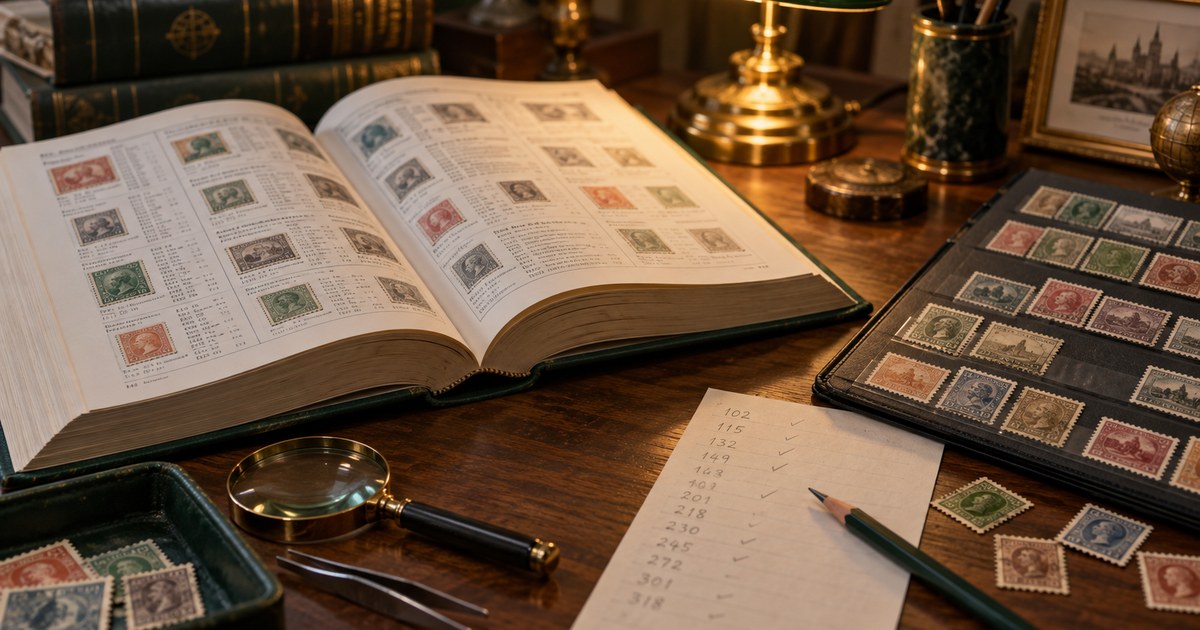
You looked your stamp up, found its number, and read a price printed beside it. Then someone in the trade looked at the same stamp and named a figure that was not close. That gap is the most common shock in the hobby, and almost nobody explains it plainly, so here is the honest version: a stamp catalogue value and a buying offer are two different measurements of two different things, and only one of them is money someone will hand you.
A stamp catalogue value is a published retail benchmark for a fine example, not an offer to buy. Stanley Gibbons prints what Gibbons itself would charge; Scott samples what a buyer might pay in the retail market. A dealer buying your stamp pays a fraction of that, because the cost, the delay and the risk of finding the next owner all move to them.
None of this means the catalogue is lying to you. It means you are reading the wrong column for the question you are asking.
What does stamp catalogue value actually mean?
It depends on which catalogue you are holding, and the two big ones do not define the term the same way.
Stanley Gibbons treats its catalogue as a retail price list. As Wikipedia’s summary of the catalogue puts it, if Gibbons had that exact stamp in stock in the exact condition specified, the current catalogue price is the price that they would charge for it. That is a shop’s asking price, printed in advance, by the largest name in British philately.
Scott works from the other end. Wikipedia notes that the Scott catalogue includes price information based on market analysis and reported sales from the previous year, and Scott’s own guidance describes values as a sampling of what a buyer might expect to pay in the retail marketplace. Nobody at Scott is offering to sell you the stamp at that number. It is a reading taken off a market.
So one is a seller’s shelf price and one is an observed average of retail transactions. Both are retail. Neither is a bid. Linn’s Stamp News makes the same point in its guidance on catalogue values: catalogues are not dealers’ price lists, and the figures are approximations of what stamps are being sold for in the retail market.
The four different numbers your stamp has
Most confusion clears the moment you stop treating “value” as one number. A single stamp usually has four, and they are ranked:
- Catalogue value. The published benchmark, for a sound example in the grade the catalogue assumes. The highest of the four, by design.
- Dealer retail. What a shop actually asks today for that stamp in the actual condition it is in. Often below catalogue, sometimes well below, because a real stamp is rarely the catalogue’s ideal stamp.
- Realised auction price. What a bidder in an open room paid on a given day. This is the closest thing philately has to a market price, and it is a fact rather than an estimate.
- Dealer buying offer. What someone will pay you, in cash, now. The lowest of the four, and the only one that is an offer.
Quote any figure at all and you should be able to say which of those four it is. When a forum post says “my Penny Red is worth £20”, that is nearly always a catalogue number being mistaken for a bid.
How far apart are catalogue and reality?
Honestly: far enough that no responsible source publishes a single universal percentage, and you should distrust anyone who gives you one as a flat rule. The gap depends on the material.
For inherited general collections, the Swindon Philatelic Society’s valuation guidance is unusually blunt about it: collections assembled by parents or grandparents may not raise at auction more than 10 to 20 percent of their apparent value as indicated by a catalogue such as Stanley Gibbons, and unusually good or outstanding collections may perhaps attain 30 to 40 percent. Those are realised-auction figures against catalogue, published by a philatelic society rather than by anyone buying your stamps.
The auctioneer Warwick & Warwick puts the mechanism the same way from the trade side, noting that the values catalogues assign are very optimistic and that even most dealers discount their prices heavily from the values they display. The reason it gives is the one that matters most: catalogue prices are for near-perfect examples, which is unlikely to be the case with most stamps.
For a dealer’s buying offer specifically, the American Stamp Dealers Association states the constraint without dressing it up: a dealer is in business and must buy at a price that allows a fair profit when the stamps are sold. Between your kitchen table and that eventual sale sit sorting time, capital tied up in stock, show costs, and the real possibility that a given album sits unsold for years. That is what the discount buys.
The American Philatelic Society is equally direct in its estate-planning guide, which warns collectors that collections generally may be purchased for less than catalogue value, and that catalogue value, whether Scott, Stanley Gibbons or Yvert & Tellier, is almost never the appraisal valuation. The APS guide instead works in fair market value (the price between a willing buyer and a willing seller) and retail replacement value, and treats catalogue value as neither.
Why the gap gets wider
Three things stretch it, and all three usually apply at once to an inherited album.
Condition below the assumed grade. Scott values are for stamps in the grade of Very Fine unless stated otherwise, per Scott’s own listing guidance. That is a real bar involving centering and soundness, and most stamps in circulation do not clear it. A hinged, off-centre or short-perforated copy is not a discounted Very Fine stamp; it is a different item in a thinner market. The mechanics of that are laid out in what makes a stamp valuable.
Commonness. Catalogue minimums exist because printing a price for a stamp nobody would buy separately would be absurd. Scott’s guidance notes that the actual value of a set made up mostly of minimum-priced stamps may be less than the total shown. Add up a thousand minimum values and you have a large number describing material a dealer would rather not sort.
Bulk. Nobody prices an album stamp by stamp when buying it. Collections trade as lots, at lot prices, because the labour of breaking one down is the expensive part. This is exactly why the choice of sales channel changes the answer, which is the whole subject of where to sell old stamps.
So what is catalogue value good for?
A great deal, as long as you use it as a ranking rather than a price.
Within one country’s listings, catalogue values are a reliable relative scale of scarcity and demand. A stamp catalogued at fifty times its neighbour really is the harder stamp, and that ordering holds even when every absolute figure is optimistic. That makes the catalogue the fastest tool in the world for the only question that matters at the start: which few items in this album deserve a closer look.
It is also the shared language of the trade. A Scott or SG number identifies precisely which stamp you mean, which is why dealers quote numbers rather than descriptions. And it sets a sensible threshold for spending money on expertise: the APS advises inheritors to get help in person and to compare offers from more than one dealer, and a catalogue total is how you decide whether a collection is worth that effort at all. What a stamp appraisal costs is the other half of that arithmetic.
What it is not is a promise. Treat the printed figure as the ceiling of a range whose floor you will discover only by asking real buyers.
Turning a catalogue number into a real expectation
Start by identifying the stamp correctly, because a wrong number produces a confidently wrong value. Then read the catalogue as a ranking, pull out the handful of items that stand well above the rest, and get those looked at properly. Everything else in the album is worth what bulk is worth, and the honest default for a general collection is that most of it is common. The full workflow, from sorting to a defensible total, is in how to value a stamp collection.
Stampo is built for that first step. Photograph a stamp and it identifies the country, year, denomination and catalogue number, then gives a value range tiered by condition rather than a single flattering figure, so the number you carry into a conversation with a dealer is one you can defend.
Sources
- Stanley Gibbons catalogue - Wikipedia
- Scott catalogue - Wikipedia
- Understanding the Scott Catalogue Listings - Amos Advantage
- Here's what you should know about catalog values - Linn's Stamp News
- Disposing of a Collection: a guide for the collector in estate planning - American Philatelic Society
- Inherited a Collection - American Philatelic Society
- How to appraise stamps - Warwick & Warwick
- Stamp collection evaluation - Swindon Philatelic Society
- Selling A Collection - American Stamp Dealers Association