
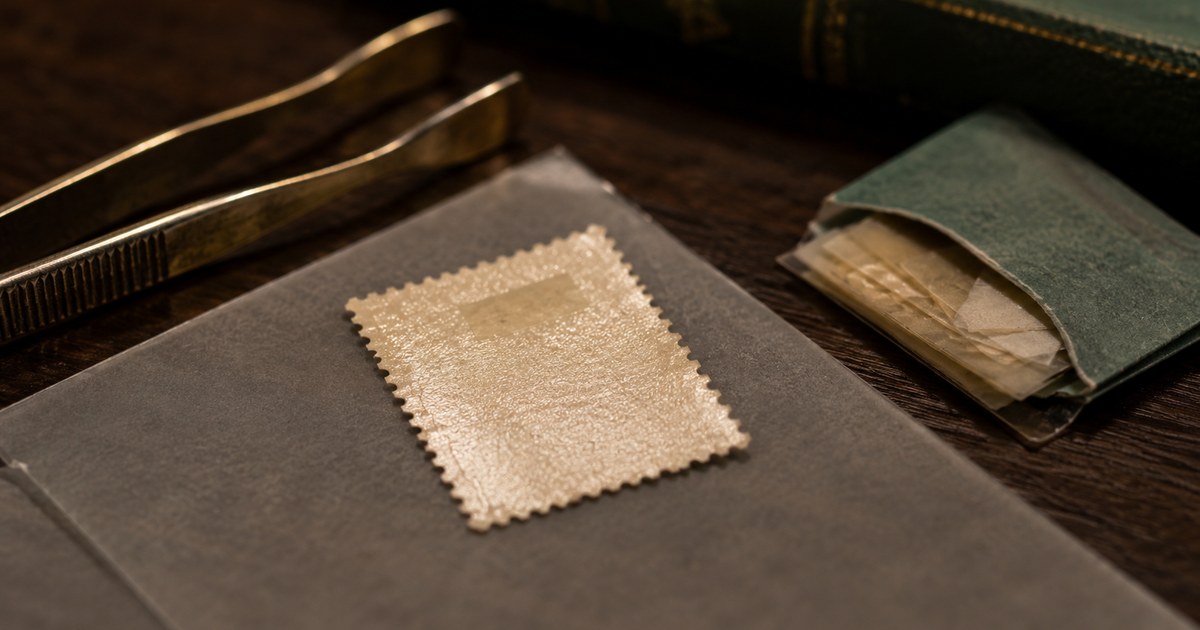
Somewhere in a dealer’s listing, an auction description, or the pencil notes in an inherited album, you have run into the letters MNH, and the mint never hinged meaning turns out to matter more than almost anything else printed on the front of the stamp. Two copies of the same issue, identical in design and colour, can sit at very different prices because of a mark on the back that nobody ever sees.
Mint never hinged (MNH) means an unused stamp that has never been mounted with a hinge and still carries its full, undisturbed original gum exactly as it left the post office. It is the top rung of a ladder that runs down through lightly hinged, hinge remnant, no gum, and finally regummed, and every step down that ladder changes what the stamp is worth.
The definition takes one sentence. The useful work is everything after it: where on that ladder your particular stamp sits, how much the drop actually costs (much less uniform than the internet suggests), and whether the gum you are looking at is even the original. That last question is the one most guides skip, and it is the one with real money riding on it.
Mint never hinged meaning: the gum ladder from MNH to regummed
Dealers use a compact set of abbreviations. They are broadly stable, but not perfectly standardised: British and American usage differ, catalogues differ from each other, and OG in particular means different things to different sellers, so read a description in the context of who wrote it. Working down from best:
- MNH (mint never hinged), also written UM (unmounted mint) in British usage. A stamp as issued, with full original gum, never previously hinged.
- OG (original gum) on its own. The stamp still has the gum it was issued with, but without NH attached this is generally taken in the trade to mean it has been hinged at some point, a usage Linn’s Stamp News sets out in its guide to stamp gum.
- LH (lightly hinged) or MH (mint hinged). A hinge was applied, and the mark it left is small or light.
- HR (hinge remnant). Part of the hinge proved so difficult to remove that it was left stuck to the stamp. This is a worse state than LH, not a cosmetic quibble.
- DG (disturbed gum). The gum has been damaged some other way, by damp, by sticking, or by an attempt at cleaning.
- NG (no gum). An unused stamp with no gum at all, either washed off, soaked away, or issued that way (some stamps were, and honest descriptions say so).
- RG (regummed). New gum has been applied in place of the original. This is the bottom of the ladder and it is the one that can cost you real money.
A hinge itself is a small gummed paper strip that collectors used for a century to fix stamps into albums. Mounts, the clear sleeves that hold a stamp without sticking to its back, only came into general use in the middle of the twentieth century, which is why so much classic mint material carries hinge marks and why genuinely never-hinged classics are scarce.
How much does a hinge actually cost you?
Not a fixed percentage, and anyone quoting you a flat “half” across the board is guessing. The honest answer is that the penalty depends on when the stamp was issued, because the catalogues themselves change their baseline by era.
Stanley Gibbons is explicit about this in its own pricing guidance. For unused stamps issued after 1936, its prices are for unmounted mint, meaning stamps never previously hinged. For earlier unused material, from Queen Victoria through King George V, its Commonwealth catalogue prices are for lightly hinged examples, where a single light hinge mark is normal and two or three carefully applied and removed hinges can still be acceptable.
Read those two conventions together and the whole picture falls out:
- On modern issues (roughly post-1936), never hinged is the benchmark. The catalogue price already assumes it, so a hinge mark is a discount from the quoted figure. Stanley Gibbons’ guidance is that modern stamps with hinge marks should be substantially discounted.
- On classic issues, hinged is the benchmark. The catalogue price already assumes a light hinge, so a hinge costs you nothing against that price, and a genuinely never hinged copy earns a premium above it instead.
- Heavy hinging is penalised hardest on the classic material. Stanley Gibbons’ guide to stamp condition sets its scale against that Queen Victoria to King George V lightly-hinged baseline: a stamp mounted on a number of occasions, or with a heavy hinge still attached, drops to roughly half catalogue and falls away fairly rapidly from there. Note that an SG catalogue price is the firm’s own estimated selling price, so read that figure as a fraction of a dealer-retail asking price rather than of an offer anyone would make you. The same guide is looser at the very old end: heavier hinging is acceptable on stamps issued before 1890 provided most of the gum is clear and unblemished.
So the headline “a hinge can halve the price” is true, and it is specifically true of heavy hinging and hinge remnants on classic material rather than of one light, cleanly removed hinge on a Victorian stamp. Gum is one input among several, alongside centring, cancellation, and damage, and we walk through how they combine in what makes a stamp valuable.
One more piece of perspective. All of this applies to unused stamps only. If your stamp has been through the post it has no gum question to answer at all, and its price turns on the postmark instead, which is the subject of whether used stamps are worth anything.
How do you spot a regummed stamp?
This is the part that matters if you are about to hand over money, because the gap between original gum and no gum creates a direct financial incentive to fake it. Wikipedia’s entry on regummed stamps dates the incentive precisely: until the 1970s there was little difference in value between unmounted and previously hinged stamps, and a significant price difference has developed since. The practice followed the money.
The most useful first test on a classic perforated stamp is the perforation tips. Sheets were gummed first and perforated afterwards, so original gum rarely reaches the tips of the perforations, and those tips keep a slightly fibrous, hairy look from being separated. Production methods varied by issue, so treat this as the check that flags a stamp for closer attention rather than as a verdict on its own. When a stamp is regummed, the new gum is brushed or sprayed over the finished stamp, so it runs onto the perforation tips, glues those loose fibres flat, and sometimes pools in the holes themselves. Under a magnifier that is often obvious once you know to look.
The Philatelic Foundation, which examines stamps professionally, lists several more signs worth checking:
- Wrong sheen. Regummed stamps frequently look glossier than genuine gum on that issue.
- Texture faults. A crackled surface where the gum dried too fast, a layered look, faint brush strokes, or small bubbles left by spray application.
- Foreign matter. Multi-coloured gum, or a brush hair set into the gum, cannot be original.
- Missing perforation traces. Original gum usually carries faint impressions from the perforating process, and regumming erases them.
- Curl direction. Warmth from your palm makes fresh gum curl the stamp differently from a known original-gum copy of the same issue.
- Staining around the perforations, from moisture seeping through during the regumming.
Two practical warnings. Regumming is sometimes used to hide thins and tears in the paper, so a suspect back can mean a damaged stamp as well as a dishonest one. And the best defence, according to the same source, is comparison: hold the stamp against a copy of the same issue whose gum you trust. For anything where you are paying a real premium for never-hinged gum, especially classic material, an expert certificate from a recognised expertising body is the only answer worth relying on.
What this means for the album on your table
Keep the expectation honest. The gum ladder decides prices between copies of the same stamp, and it cannot rescue a stamp that was common to begin with, which is most of them, for the reasons set out in why most stamps aren’t worth much. An MNH copy of a stamp printed in the hundreds of millions is an MNH copy of a very ordinary stamp.
Where the ladder earns its keep is at the two ends of a transaction. If you are selling, describe gum accurately and never guess, because an overstated MNH claim is the fastest way to lose a buyer’s trust. If you are buying, check the perforation tips before you check anything else. And if you are simply holding a collection, the useful action is to stop hinges reaching anything mint from here on, which is covered in how to store a stamp collection.
Start by finding out what the stamp actually is. Photograph it with Stampo and you get the country, year, and catalogue identification in seconds, plus an honest value range tiered by condition, so you know whether the gum question in front of you is worth answering carefully or is a detail on a stamp worth cents either way.
Sources
- Mint stamp - Wikipedia
- Regummed stamp - Wikipedia
- Has Your Stamp Been Regummed? - The Philatelic Foundation
- Philatelic terms explained: A guide to stamp collecting abbreviations - Warwick & Warwick
- The Stanley Gibbons Guide to Stamp Pricing
- A guide to stamp condition and value (Stanley Gibbons, archived)
- Postage stamp gum, a very sticky subject - Linn's Stamp News
- Hinged vs Never Hinged Stamps - Stamp Collecting Spot