
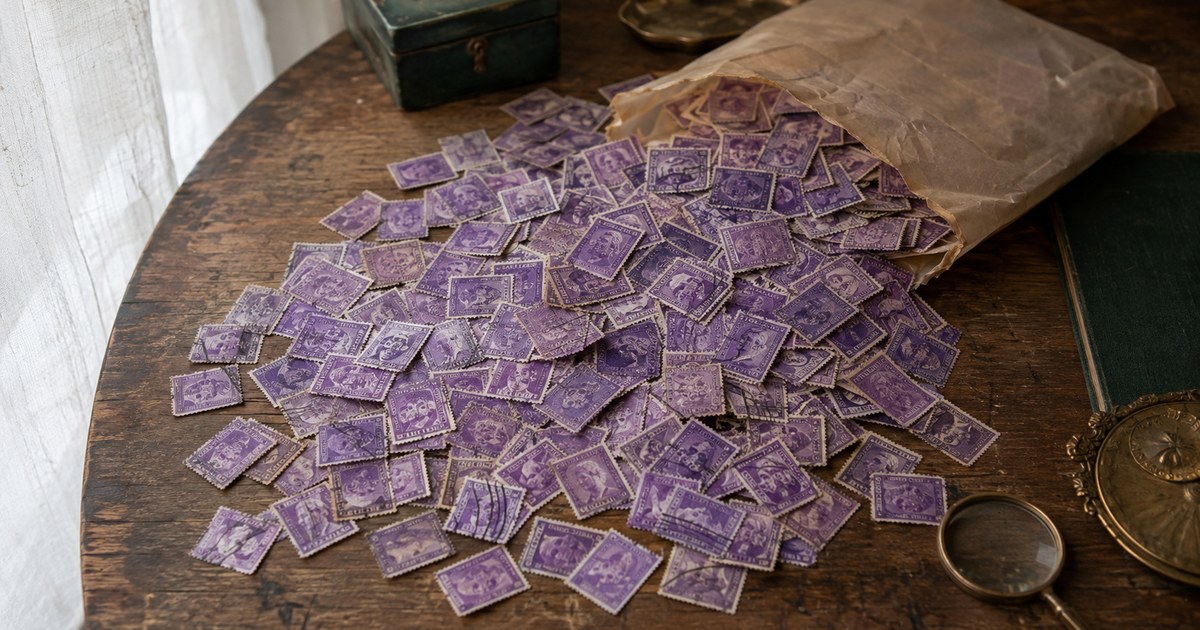
Open any American album put together before about 1960 and the dominant colour is purple. Page after page of 3 cent stamps: Washington in profile, then Jefferson, then the Statue of Liberty, then a parade of commemoratives for state anniversaries, war efforts, and inventions nobody remembers. Anyone asking about 3 cent stamp value is usually looking at a hundred of them at once, which is the first clue about the answer.
Most 3 cent stamps are worth a few cents. The 3 cent first class letter rate ran from 1932 to 1958, so the purple Washington of 1932 and the wave of 3 cent commemoratives that followed were printed in enormous numbers. Mystic Stamp Company retails a used Scott 720 at 35 cents and a mint one at 50 cents (both dealer retail).
The useful work is not pricing the pile. It is separating the ordinary sheet stamps, which are the overwhelming majority, from the four or five formats that genuinely carry a premium, and that separation comes down to looking at the edges rather than the picture.
Why are 3 cent stamps so common?
Because one denomination carried American first class mail for twenty six years. In the summer of 1932 the letter rate rose to three cents, and it stayed at three cents until August 1, 1958, when it went to four. The United States Postal Service publishes the full table of domestic letter rates since 1863, and no other rate that began in the twentieth century lasted anything like as long. Only the 2 cent rate of 1885 to 1917, which straddles the turn of the century, ran longer.
Scott 720, the 3 cent Washington in deep violet, was issued on June 16, 1932 in Washington, DC to meet that change. Mystic Stamp Company’s own listing explains the shortcut the Bureau took: the design was adapted from the 2 cent Washington Bicentennial stamp of the same year, with the denomination and colour changed and the 1732 and 1932 ribbons removed. The portrait is Gilbert Stuart’s, the same one on the dollar bill, which is why it feels familiar before you have consciously looked at it.
Then the rate outlived the stamp. Scott 720 gave way to the 3 cent Jefferson of the 1938 Presidential Series, which gave way to the 3 cent Statue of Liberty of the 1954 Liberty Series, and running alongside all three was a steady stream of 3 cent commemoratives, because a commemorative is only bought if it pays the current letter rate. Twenty six years of that produced a supply of purple stamps that the collector market has never come close to absorbing.
If any single stamp deserves the label most common in America, the 3 cent purple Washington family is the strongest candidate, and the reason is arithmetic rather than sentiment. The same forces that price it also price the red 2 cent stamps on the next page, which we cover in George Washington 2 cent stamp value.
What is the honest 3 cent stamp value?
Three tiers. Every figure below is an asking price from a large dealer, not an offer you would receive, and the difference between those two numbers is most of what people find surprising about this hobby:
- Used singles. Cancelled 3 cent stamps are the most common survivors of the period by a wide margin. Mystic retails a used Scott 720 at 35 cents (dealer retail), and that is a large dealer’s asking price for a hand picked sound copy. Bulk used accumulations are bought by weight or by the thousand, not by the stamp. How the postmark itself affects that figure is covered in are used stamps worth anything.
- Mint singles. A sound mint copy sits in the same neighbourhood: Mystic lists Scott 720 mint at 50 cents, rising to 1.30 dollars for a mint very fine never hinged example (both dealer retail). The premium is for genuinely good centering and undisturbed gum, nothing else.
- Full sheets. Mint 3 cent sheets remain valid postage, so their practical floor is face value: a hundred stamp pane is three dollars of postage. An intact, well centred sheet does carry a collector premium above that, and Mystic lists a Scott 720 mint sheet at 75 dollars (dealer retail). Read that as a dealer’s asking price rather than an offer, because a dealer buying sheets from you needs resale margin and pays a fraction of it. That gap is why sheets of 3 cent commemoratives from the 1940s and 1950s, printed for collectors and saved by everyone, so often change hands at or barely above their face value.
The results you get searching this question are mostly marketplace category pages, which show what sellers hope to receive rather than what stamps change hands for. Treat every asking price as a ceiling.
Which 3 cent stamps are the genuine exceptions?
They exist, and they are all about format or printing rather than the picture on the stamp:
- The coil perforated 10 vertically, Scott 721. Issued June 24, 1932, with straight edges at top and bottom. Mystic retails it at 3.95 dollars mint and 35 cents used (both dealer retail).
- The coil perforated 10 horizontally, Scott 722. Issued October 12, 1932, with straight edges at left and right. Mystic notes it was used only in certain vending machines and puts the quantity issued at 35,988,000 across eight years of production, which for this period is a small number. Mystic retails it at 2.95 dollars mint and 1.25 dollars used (both dealer retail).
- The intact booklet pane, Scott 720b. A complete pane of six from a stamp booklet retails at 42.50 dollars at Mystic (dealer retail), against 50 cents for a mint single. Almost every booklet ever sold was torn apart and used, which is the entire reason for the gap. If a pane of six is still whole in an album, do not separate it.
- Genuine imperforate errors. Sheet stamps that escaped the perforating machine are collectable and certifiable. They are also the category most often claimed and least often real, for the reason in the next section.
Notice what is not on this list: colour that looks darker or lighter than the album next to it, a crisp postmark, a plate number in the margin, or a first day cover. Those are pleasant. They are not scarce.
How do you tell a common 3 cent stamp from one worth certifying?
Work down this tree in order. It takes about a minute per stamp and it resolves nearly every case.
- Step one: count the straight edges. Perforations on all four sides means a sheet stamp, which is the common outcome and where most of the pile will land. Straight edges on two opposite sides means a coil. One straight edge with the stamp still attached to five others means a booklet pane.
- Step two: if it is a coil, note which way the perforations run. Perforations on the left and right edges only is Scott 721, the perf 10 vertically coil. Perforations on the top and bottom edges only is Scott 722, the perf 10 horizontally coil. Collectors call these the vertical and horizontal coils, and the two labels get swapped often enough that the perforation direction is the safer thing to record.
- Step three: if it has no perforations at all, check the back for gum. This is the step that saves people money. In 1935 the Post Office sold a set of special printings, catalogued Scott 752 to 771 and known as Farley’s Follies, which were ungummed and in most cases imperforate, on sale at the Philatelic Agency in Washington for three months only. Mystic’s account of the episode explains that they were produced in quantities large enough to satisfy demand. Several of them are 3 cent stamps, which is why they land in this pile so often. Check the design before you get excited: the Farley printings reproduce commemoratives of the early 1930s, not the plain Washington profile of Scott 720, so an ungummed imperforate commemorative is almost certainly a Farley, while an ungummed imperforate 720 is more likely to be a stamp whose gum was washed off than an error.
- Step four: imperforate plus original gum plus normal sheet margins is the one to pursue. That combination is what a genuine perforating error looks like, and it is worth submitting to an expertising service for a certificate.
- Step five: apply the cost test before you submit anything. Certification is a paid service. If the best case value of the stamp is not comfortably above the cost of the certificate plus postage and insurance, the certificate is the more expensive object.
One more habit worth keeping: photograph anything ambiguous before you handle it repeatedly. Creases and thins acquired during examination are permanent, and on the exceptions above they remove most of the premium you were trying to confirm.
The honest verdict on the purple pile
Statistically, the 3 cent stamps in your album are common, they are worth cents each, and the sheets are worth their postage. That is not a failure of the collection; it is what happens when a single denomination carries a nation’s mail for twenty six years, and the stamps did exactly the job they were printed for.
The value in the pile, if there is any, is in the handful of coils, panes, and errors described above, and you find those by checking edges rather than by hoping. If you want the reasoning behind why survival and format decide this and age does not, it is set out in what makes a stamp valuable, and the broader picture of which American issues are genuinely scarce is in our United States stamp values guide.
For the fast version, work through the pile with Stampo: a photograph of each stamp comes back with the issue, the catalogue number, and a value range tiered by condition rather than a single hopeful figure, which means you can retire ninety of a hundred purple stamps in a few minutes and spend the rest of your attention on the two or three that came back interesting.
Sources
- 720 - 1932 3c Washington, Deep Violet - Mystic Stamp Company
- 720b - 1932 3c Washington, Deep Violet, Booklet Pane of 6 - Mystic Stamp Company
- 721 - 1932 3c Washington, Purple, Perf. 10 Vertically - Mystic Stamp Company
- 722 - 1932 3c Washington, Purple, Perf. 10 Horizontally - Mystic Stamp Company
- What are Farley's Follies? - Mystic Stamp Discovery Center
- Rates for Domestic Letters Since 1863 - United States Postal Service