The penny black plate 11 search usually starts with a magnifier and ends in confusion: people scan the edges of their stamp for a tiny printed “11” and cannot find one. There is a good reason for that. No Penny Black, from any plate, carries a printed plate number anywhere in its design.
The Penny Black was printed from 11 numbered plates, and Plate 11 is the rarest: about 168,000 stamps printed in black in February 1841, out of 68.8 million overall. No plate number appears on the stamp itself, so identifying Plate 11 relies on check-letter positions and known plate flaws, confirmed by an expert certificate.
That combination, a genuinely rare printing with no visible number, makes Plate 11 both the most interesting Penny Black and the easiest to claim wrongly. Here is how the plates worked, how specialists pin a stamp to Plate 11, and what an honest valuation of one looks like.
Why penny black plate 11 is the rarest printing
The Penny Black had a short life and an enormous print run: 286,700 sheets, or 68,808,000 stamps, produced from 1840 into early 1841. Eleven numbered plates did the work, and because Plate 1 was completely overhauled after heavy wear, collectors count its two states (1a and 1b) separately, giving twelve plates in practice. The first plate alone accounts for over 10 million stamps, which is why almost any Penny Black you meet comes from a common plate.
Plate 11 is different because it was never meant to print black stamps at all. It was built to print the Penny Red, the replacement colour chosen so that cancellations would show up better. The very first printings from Plate 11, in late January 1841, were in red; it is the only Penny Black plate where red came first. Then the supply of black stamps ran short before the changeover was complete, so a stopgap printing of 700 sheets was run in black, beginning on 1 February 1841. Seven hundred sheets of 240 stamps is about 168,000 stamps, against 68.8 million for the issue as a whole. That is the entire reason Plate 11 matters.
There is no printed “11” on a Penny Black
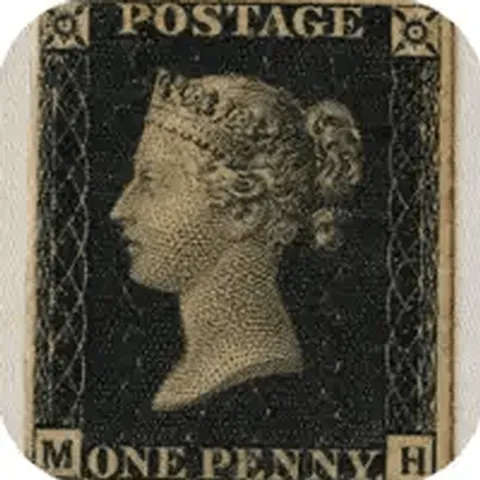
Worth repeating, because most people searching this topic assume otherwise. The letters in the bottom corners of a Penny Black are check letters, and they encode the stamp’s position on the sheet, from AA at top left to TL at bottom right. They say nothing about which plate printed it. Printed plate numbers, the small figures woven into the side lacework, only arrived with the later Penny Reds, the 1864 to 1879 issues we cover in our Penny Red value guide. If someone offers you a Penny Black “with plate number 11 shown”, walk away: the stamp they are describing cannot exist.
How specialists actually identify a Plate 11
Attributing a Penny Black to its plate is called plating, and it works because the plates were finished by hand. The corner check letters were punched into each plate individually, so no two plates have the letters sitting in quite the same position in their squares. Add the small differences in the corner stars, the guide lines used to align the engraving, and the recorded flaws that developed in service (plates 7 to 10, for example, share a small flaw on the O of ONE), and a specialist can match a stamp against plate reconstructions with real confidence.
For Plate 11 specifically, the reference points published by plating guides include a broken top line on the north-east corner square, a faint top-right serif on the E of POSTAGE, and a missing ray in the right-hand star. Cancellation colour is a useful quick filter too: by February 1841 the red Maltese Cross cancel had given way to black, so genuine Plate 11 blacks almost always carry a black cross. A Plate 11 with a red cross is a celebrated rarity on top of a rarity.
None of this is kitchen-table work. The honest position is that plating a Penny Black takes reference material and experience, and a Plate 11 attribution only carries market weight with a certificate from an expert body such as the Royal Philatelic Society London or the BPA. Dealers and auction houses treat uncertified Plate 11 claims as what they statistically are: common plates.
What is a genuine Plate 11 worth?
Start with the baseline. Per Warwick & Warwick’s dealer guide, ordinary used Penny Blacks run about £15–£30 in poor to reasonable condition, £40–£150 for better examples, and £250–£400 for fine used copies with clear margins; unused examples start around £1,250 and climb steeply. Those are dealer-guide retail figures, and condition, especially the four margins, decides where a stamp sits, as we explain in our Penny Black checks.
A certified Plate 11 sits well above a common plate in equivalent condition, because it is the scarcest printing of Britain’s most famous stamp and the plate every serious collection wants. Certified examples trade infrequently enough that there is no reliable fixed price: each sale is set at auction or by negotiation, driven by margins, cancellation, and the certificate itself. Be suspicious of any site quoting a confident single number for “a Plate 11”. The red Maltese Cross examples sit at the very top of the range, and those are museum-grade rarities.
The honest odds for the one in your album
Fewer than one Penny Black in 400 came from Plate 11: 168,000 stamps out of 68.8 million printed. Around 1.3 million Penny Blacks survive today across all plates, so owning a Penny Black is genuinely common, and owning a Plate 11 is genuinely not. The default assumption for any album stamp is a common plate, and wishful plating, squinting a common plate’s flaws into Plate 11’s, has parted a lot of people from appraisal fees over the years.
The two-minute route: photograph your stamp and let Stampo identify what you have, including an honest, condition-tiered value range for a normal Penny Black. If the check letters and characteristics genuinely point toward the scarce end, the next step is an expert certificate, not a listing. And for everything else Victorian in the album, our Great Britain stamp values guide covers the wider field.
The genuine article
So you can compare against the real thing — these are genuine, public-domain reference images, not illustrations: