
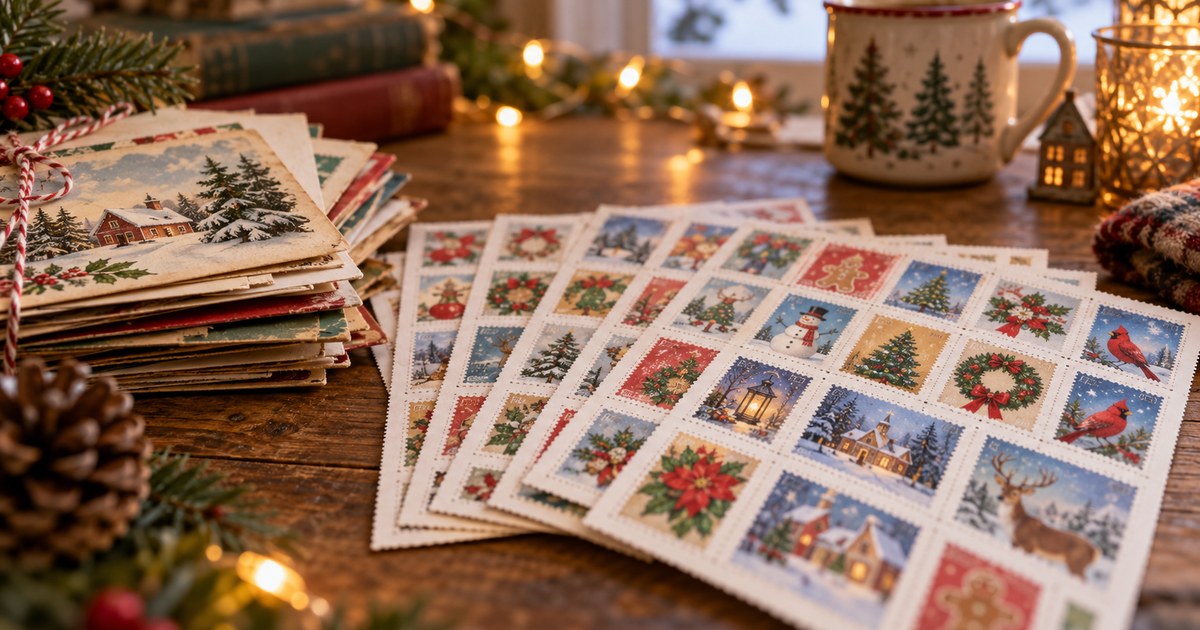
Every December a fresh sheet of holiday stamps arrives, and every few years someone finds an old one tucked in a drawer and wonders whether decades of Christmas stamps quietly added up to something. Christmas stamps value is one of the more disappointing searches in this hobby to answer honestly, mostly because the stamps were designed from day one to be bought by the sheet by people who never planned to spend them, which is exactly the arithmetic that keeps prices low.
Most Christmas stamps are worth face value or less. They were printed in the hundreds of millions to billions specifically because everyone used them every winter, so mint sheets in a drawer are worth their postage rather than a collector premium. Real value, where it exists, sits in a small number of documented early issues and printing errors, each one a specific, verified exception rather than a rule of thumb.
That is the whole shape of the answer. The rest is knowing which drawer find is the genuine exception and which is just another common sheet.
Why are Christmas stamps printed in such enormous quantities?
Because everyone needs one at the same time of year, which is the opposite of the conditions that create a scarce stamp. The United States issued its first Christmas stamp on 1 November 1962, a 4-cent design of a wreath and two candles by postal artist Jim Crawford, according to USPS’s own account of the issue. Two separate figures describe just how large that first run was: Mystic Stamp Company’s own listing puts the catalogued quantity issued at 861,970,000, while USPS’s own history of the issue describes an initial run of about 500 million that sold out so fast the Post Office Department kept printing until total production for the year reached roughly a billion stamps, a scale unheard of for a single commemorative at the time. Either figure alone makes the point: this was never going to be a scarce stamp. That is the pattern for essentially every Christmas commemorative since: printed by the hundreds of millions to over a billion because the entire country buys stamps for cards in the same six-week window, then largely used up on actual mail.
Britain’s holiday stamps follow the same population logic from a different starting point. According to the Association of British Philatelic Societies’ account of their origins, and the Postal Museum’s own history of the issue, Royal Mail’s first Christmas stamps appeared on 1 December 1966, the result of a nationwide children’s art competition run with the Blue Peter television programme; the winning designs, King Wenceslas and a snowman, came from two six-year-olds among more than five thousand entries. Christmas commemoratives have been an annual fixture in Britain ever since, printed every year in quantities matched to the whole country’s card-sending mail, which puts the ordinary run in the same common category as the American issues.
The honest default follows directly from those print runs. A sheet or a handful of loose Christmas commemoratives from any recent decade is worth its face value as postage, and little more, for the same reason why most stamps aren’t worth much explains for the wider hobby: printed for universal, simultaneous demand, saved by millions of people at once, worth almost nothing individually as a result. The extreme case is the best-selling stamp ever, covered in Elvis stamp value.
The Christmas seal mix-up
Before valuing anything, separate one thing that is not a stamp at all, because this confusion is the single most common one in this topic. Christmas seals, the small decorative labels raising money for tuberculosis charities and their successors, are not valid postage and never have been. Wikipedia’s account of Christmas seals is explicit: they are not valid for postage and exist purely as fundraising labels, a distinction the U.S. Post Office itself moved to reinforce early on because the seals were sometimes mistaken for real postage stamps. If your sheet reads like a fundraising appeal, carries no country name or a health-charity logo, and was never meant to go on the same corner as a real stamp, it is a Christmas seal, and it belongs to an entirely separate, mostly low-value collector market rather than the postage-stamp one.
Genuine Christmas postage stamps always carry the country’s name (or, for British stamps, the monarch’s profile in place of one) and a denomination that matched a real postal rate at the time of issue. That single check sorts almost every ambiguous find in seconds.
Are there any Christmas stamps worth real money?
A narrow few, and every one of them is a specific, verified case rather than a category you can assume you have.
Documented printing errors. Christmas stamps are ordinary commemoratives at production time, which means they are just as capable of a genuine printing mistake as anything else the post office issues, and a handful of well-known ones exist. The 1979 United States 15-cent Santa Claus Christmas tree ornament stamp is the clearest American example: Scott separately catalogues two missing-colour varieties of it, with green and yellow omitted on one and green, yellow, and tan all omitted on the other, as Linn’s Stamp News describes in its account of the issue. A catalogued error like this is a documented, verified rarity precisely because Scott lists it as its own number rather than folding it into the ordinary stamp, which is a strong signal that a real production accident, not an amateur alteration, is behind it. Treat any unlisted “error” you find yourself with real suspicion, and get anything that looks genuinely unusual expertised before assuming it matches a catalogued variety.
Colour and perforation errors more broadly. The same categories that make any stamp valuable, inverted or missing colours, an accidentally imperforate sheet, apply to Christmas issues exactly as they do to every other commemorative, and for the same reason: the error is scarce against a background of hundreds of millions of ordinary copies. None of these should be assumed from a description alone. A certificate from a recognised expertising body is the only thing that turns a plausible claim into a defensible one.
The earliest issues, in genuinely fine condition. A first-year Christmas stamp, especially one that is unused with full original gum rather than the far more common used, cancelled kind, carries a modest premium over later, even more common years, simply by being first. This is a small premium, not a windfall, and it disappears entirely if the gum has been hinged or the stamp shows handling wear.
Outside those specific, checkable cases, the honest expectation holds: a Christmas stamp from any era in your album is postage-grade material, not collector material. The same five factors that decide any stamp’s price, covered fully in what makes a stamp valuable, apply here without exception: a Christmas stamp gets no special treatment just for being seasonal.
What about first day covers of Christmas stamps?
This is the format most people actually find, because a first day cover, a stamp cancelled on its official release date on a decorated envelope, was a popular way to mark the season for decades. The overlap with the wider first day cover market is complete: first day cover value explains why the overwhelming majority of mass-produced, cacheted covers, Christmas ones very much included, sell for very little regardless of how old or how nicely illustrated they are. A Christmas first day cover from a mainstream year is common precisely because so many people bought one deliberately to keep, which defeats scarcity just as thoroughly as a mint sheet in a drawer does.
Are unused Christmas stamps still spendable postage?
Usually, yes, which is worth knowing before writing off a stack of unused sheets entirely. In the United States, stamps issued from 1861 onward have never been demonetized and remain valid for postage indefinitely, per Wikipedia’s account of the country’s demonetization policy, so an unused sheet of any American Christmas commemorative, however old, is still worth its printed face value as actual postage. Other countries set their own rules, and some, Britain’s recent barcode requirement for definitives among them, have tightened the pattern in ways that do not automatically extend to commemorative issues like Christmas stamps, so check your own postal service’s current policy rather than assuming either pattern by default.
What to do with the sheets in front of you
Separate any seals from any real stamps first, since that single check resolves most of the confusion in this topic outright. Set aside anything from the first year or two of any country’s Christmas series, and anything with a colour or perforation that looks genuinely wrong rather than merely faded, for a closer look. Everything else, which will be the overwhelming majority of the pile, is either spendable postage or a pleasant seasonal keepsake, and neither of those is a disappointing outcome for a stamp that was never designed to be rare in the first place.
If something in the stack looks like it might be a documented error rather than an ordinary issue, photograph it with Stampo for an identification and an honest, condition-tiered starting point before you go looking for an expert opinion. For the used, cancelled bulk that makes up most Christmas stamp finds, are used stamps worth anything covers exactly how much a postmark can and cannot change the number.
Sources
- First Christmas - USPS Employee News
- 1205 - 1962 4c Christmas Wreath & Candles - Mystic Stamp Company
- Is this 1979 Christmas stamp an error or printer's waste? - Linn's Stamp News
- Christmas seal - Wikipedia
- The Origins of Christmas Stamps - ABPS
- 1 SPECIAL STAMP HISTORY Christmas 1966 - Postal Museum
- Postage stamp demonetization - Wikipedia