
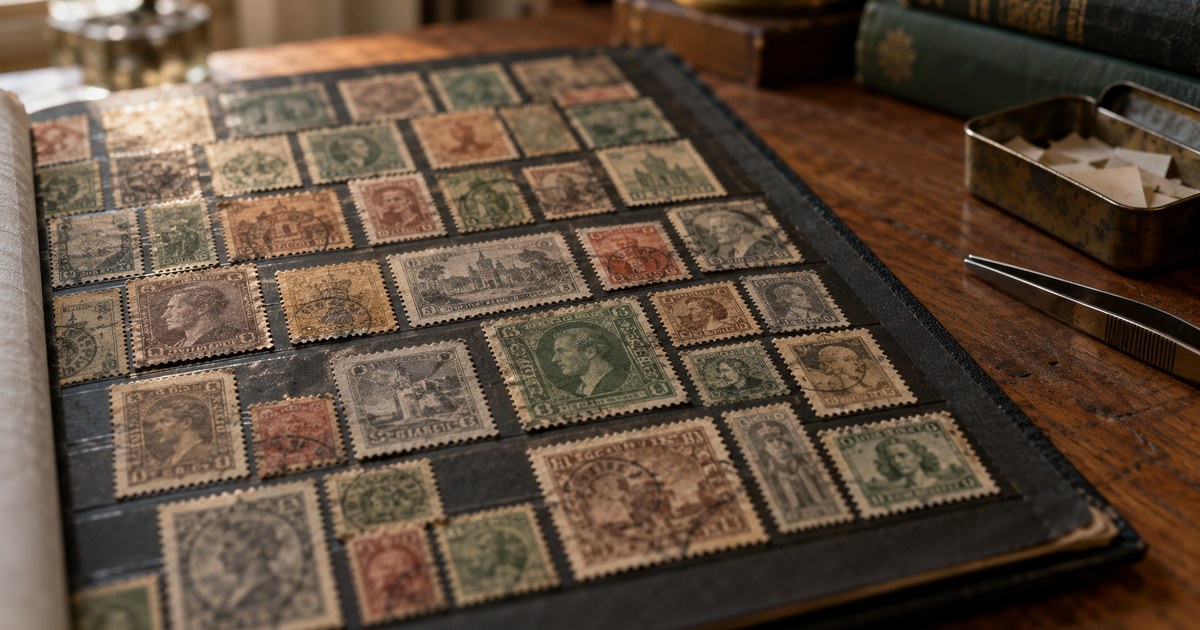
German stamps arrive in inherited collections with more baggage than almost any other country’s. There are the inflation stamps with absurd denominations, the pages of Hindenburg and Hitler heads that make people uneasy to even own, and somewhere, the family story that one of them must be rare. The German stamps value question deserves a straight answer, and the straight answer is that the stamps people most expect to be valuable are the most common stamps Germany ever printed.
Most German stamps are worth a few cents each. The 1919 to 1923 inflation issues and the 1930s and 1940s definitives were printed in enormous quantities and survive by the million, so dealers sell them by the packet. Real value sits in a short list of exceptions: early German states, a few 1930s commemorative and airmail sets, and genuine varieties.
This article explains why the base rate is so low, then names the exceptions with sourced figures, then gives you the checks that tell one from the other.
Why the German stamps value baseline sits near zero
Three accidents of history turned German stamps into the cheapest classic material in the hobby.
The first is hyperinflation. In early 1923, as Mystic Stamp Company’s description of its inflation collection puts it, a domestic letter that cost tens of marks to mail at the start of the year cost tens of billions of marks by December. The Reichspost could not design and print new stamps fast enough, so it overprinted stocks of lower values with new denominations, from 5,000 marks up to 2,000,000 marks, and then printed numeral designs in the millions and billions. Every one of those stamps was produced in vast numbers for a postal system that was burning through them daily, and when the currency was replaced the leftover sheets went straight into collectors’ hands. Mystic sells a collection of 97 different 1923 inflation stamps for $22.95 (dealer retail), which works out to under 25 cents a stamp, and that is retail for a curated set.
The second is the definitive series of the 1930s and 1940s. The Hindenburg Medallion definitives, first released on 1 October 1932 according to the Brief History catalogue of the period, carried Germany’s mail for most of a decade. They were replaced from August 1941 by the Hitler head definitives, a long run of values from 1 pfennig up to the Reichsmark denominations, issued between 1941 and 1945, as World of Collecting’s guide to the issue records. These stamps were on every letter in Germany and occupied Europe for years, so used copies exist in quantities nobody has tried to count. Mystic lists a mint set of eleven Hitler head definitives for $3.95 (dealer retail): about 36 cents a stamp, unused, from a retail dealer. World of Collecting’s own summary is that most are worth just a few pence, with used copies from 1944 the only ones that cost a little more.
The third is sheer volume across the whole country. Mystic’s packet of 300 different German stamps, spanning the Empire, Weimar, the Third Reich, East and West Germany and the reunified republic, sells for $15.95 (dealer retail), or about five cents per stamp. When a dealer can assemble three hundred different stamps from a country and sell them for that, the ordinary stamps from that country are not a store of value. This is the same arithmetic we lay out for every country in why most stamps aren’t worth much.
Are Hitler stamps worth anything?
This is the question people actually type, so it gets its own answer. The Hitler head definitives, the Hindenburg heads and the run-of-the-mill Third Reich commemoratives are worth cents, for the reasons above. The portrait does not add value; if anything, the subject narrows the market, because many collectors do not want the material and some marketplaces restrict it.
That restriction is worth understanding before you try to sell: the large marketplaces publish rules on Nazi-era material and they differ on which postal items are allowed, so read the policy of wherever you plan to list first. The practical result is that these stamps trade in a smaller pool than their age suggests, which keeps prices down rather than up.
The exceptions within the Third Reich period are the sets that were printed in small numbers for collectors or for a purpose, not the everyday definitives. The best known is below.
The 1933 Wagner set: the Reich stamps that are worth money
On 1 November 1933 Germany issued nine semi-postal stamps showing scenes from Richard Wagner’s operas, from Tannhäuser on the 3+2 pfennig to Parsifal on the 40+35 pfennig, with the surcharge going to the Deutsche Nothilfe winter relief fund. The designs by Alois Kolb are striking, which is part of the demand, but the value comes from the numbers. Stamps of the World records the printings: 1,818,070 of the lowest value and only 264,238 of the 40+35 pfennig, with the other high values in the hundreds of thousands. For a country that was about to print definitives in the billions, those are small runs.
Linn’s Stamp News reports that the Scott Classic Specialized Catalogue values the complete set at $387.50 in very fine unused hinged condition and $2,360 mint never hinged (catalogue values), and suggests that a hinged set is a reasonable buy at up to $275 (Linn’s suggested buy price). Note the gap: the never-hinged premium is roughly six times, which makes gum condition the whole question for this set, a distinction we explain in what makes a stamp valuable. Two perforation varieties exist, and the set has been faked and regummed, so a complete set with full original gum should be bought and sold with an expert certificate.
A handful of other 1930s sets sit in the same category: the overprinted Zeppelin airmails for the 1931 polar flight, for example, which were issued for a single expedition that met a Soviet icebreaker in the Arctic, as the Rossica Society’s account of the flight describes. These are collected as specialist material and priced accordingly, and they are also heavily forged, which brings us to the general rule for German overprints: an overprint on a common stamp is the easiest thing in philately to fake, and a valuable German overprint without a certificate should be assumed to be a fake until proven otherwise.
The German states: where the real rarities live
Before 1872 there was no single German post. Bavaria, Saxony, Prussia, Württemberg, Hanover, Baden and the rest issued their own stamps, and this is where German philately keeps its rarities.
The famous one is the Saxony 3 pfennig red, the Sachsendreier, Saxony’s first stamp, issued on 29 June 1850. Wikipedia’s account gives the figures: 500,000 were printed and 463,118 sold, yet only about three or four thousand survive, because three pfennig was the newspaper rate and most copies were torn when the wrapper was opened. Wikipedia puts the price at around $30,000 for a single stamp and around $220,000 for a block (reported market prices, basis not stated), and notes that the stamp has often been forged. If you have one, assume it is a forgery or a reprint until an expert says otherwise, and do not clean it.
Bavaria’s one kreuzer black, issued on 1 November 1849 as the first stamp anywhere in what is now Germany, is the other famous name from the states, and it shows the gap between famous and rare. Wikipedia records 832,500 printed and describes the stamp as valuable but not especially rare, citing the 2002 Scott catalogue at $600 unused and $1,600 used (catalogue values, and two decades old, so read them as an order of magnitude rather than a price). It has also been forged many times, so a certificate is part of what a buyer pays for.
Most German states stamps are not in that league, but the early issues of Bavaria, Baden, Hanover and the Thurn and Taxis postal service are genuinely collected and genuinely priced, with imperforate copies showing four full margins commanding the premiums and faulty or close-cut copies trading for a small fraction of catalogue. They are also the part of a German collection where watermarks and paper decide the price, so how to see stamp watermarks is the first skill to learn before you look up a states stamp.
Postwar Germany: West, East and the base rate again
After 1945 the pattern repeats. The occupation-zone issues of the late 1940s include some scarce overprints and some common ones, and once again the overprints are the forgery magnet. From 1949 the Federal Republic (West Germany) and the Democratic Republic (East Germany) each printed stamps for forty years, and both printed them in modern quantities. The attractive pictorials and the socialist-realist designs are enjoyable to collect and cheap to buy; they make up a large share of Mystic’s 300-different Germany packet, at the few cents per stamp quoted above. A few early West German commemoratives and a few East German issues withdrawn shortly after release carry real premiums, but they are the exceptions that a catalogue identifies, not the rule.
Five checks that place your German stamp
Working through these in order sorts a page of German stamps into “packet material” and “look this up properly” in a few minutes.
- Read the country name. Deutsches Reich (1872 to 1945), Deutsche Bundespost (West), Deutsche Demokratische Republik or Deutsche Post (East), or a state name such as Bayern or Sachsen. Only the states and a thin slice of the Reich period hold the rarities.
- Read the denomination. Values in thousands, millions or milliarden of marks are 1923 inflation stamps and are common, whether mint or used. Treat them as a historical curiosity, not an asset.
- Identify the design. A Hindenburg or Hitler head is a definitive and is worth cents. A pictorial from the 1930s with a surcharge (two numbers joined by a plus sign) is a semi-postal and is worth checking: the Wagner set is one of these.
- Look for an overprint. Any overprinted German stamp with a quoted value above a few dollars needs expertising, because overprints are where the forgeries concentrate.
- Check the gum. For the sets that do carry value, mint never hinged is the condition the catalogue prices assume, and a hinge mark removes most of the premium.
Stampo does the first three steps from a photograph, reading the inscription, denomination and design and returning the catalogue number with a condition-tiered range. It will tell you quickly that the milliarden mark numeral is common and the surcharged opera scene is not, which is the triage most inherited German collections need. For the broader list of which categories of stamp pay, across every country, see what stamps are worth money.
Sources
- MP2099 - 1923 Germany Inflation Stamps Collection, 97 Stamps - Mystic Stamp Company
- 50922 - 1941-42 Germany Adolf Hitler Heads, Third Reich, 11 Stamps - Mystic Stamp Company
- M3306 - Germany, 300 Different Stamps - Mystic Stamp Company
- Your guide to Hitler stamps - World of Collecting
- Mi.467-473: von Hindenburg (1 October 1932 issue) - Brief History
- Germany - Third Reich 1933 Wagner - Stamps of the World
- Dramatic designs highlight Germany 1933 Wagner semipostals - Linn's Stamp News
- Sachsen 3 Pfennige red - Wikipedia
- One kreuzer black - Wikipedia
- The July 1931 Flight of the Graf Zeppelin - Rossica Society