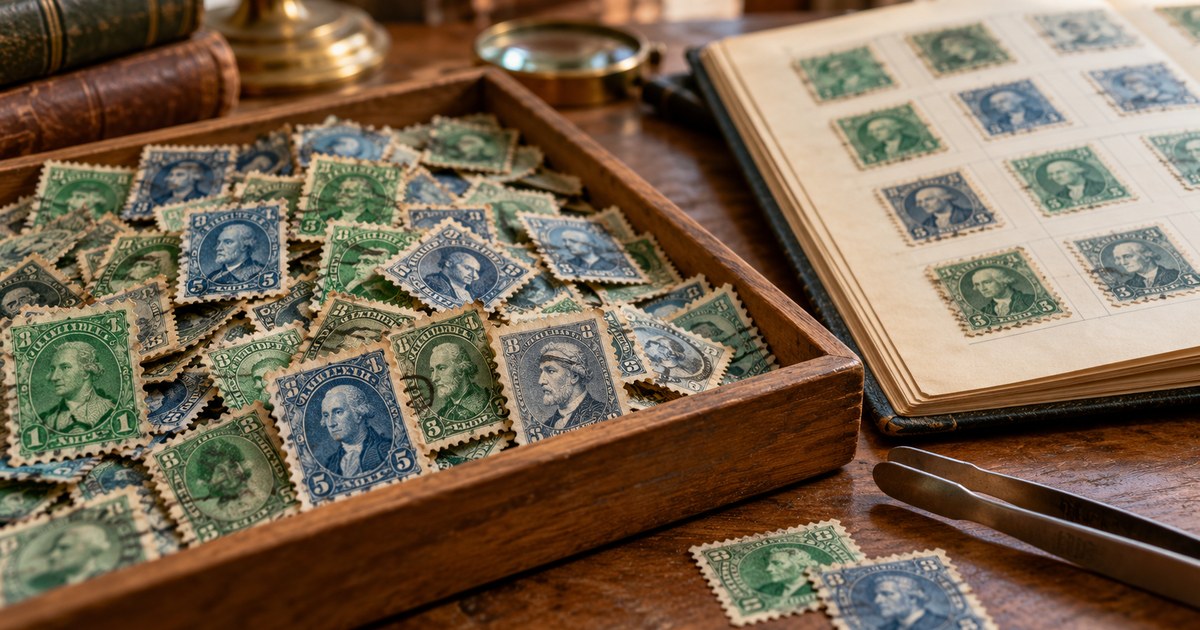
One cent stamps are the filler of American albums. They were the make-weight on every parcel and the stamp that paid the postcard and the drop letter for decades, so they turn up by the hundred, usually in green, usually with a familiar profile on them. The question of 1 cent stamp value has the same shape as the one for every low denomination: there is no single number, because the denomination spans more than 170 years, and the era decides the answer before condition gets a vote.
Most 1 cent stamps are worth a few cents. The main one cent definitives from 1938 onward were printed in enormous quantities and list at dealer minimums; the 1870s to 1920s issues are worth a little more; and only the 1851 to 1868 Franklins are genuinely scarce, with the famous Z grill the extreme outlier at over four million dollars.
Below is the whole denomination, sorted into bands, with sourced dealer-retail and auction figures so you can see which band yours falls into.
Why 1 cent stamp value depends on the era
The one cent denomination has been continuously useful since 1851, which is both why so many exist and why the early ones are scarce. In the 1850s a one cent stamp paid for circulars, drop letters and newspapers, and the Post Office issued it in modest numbers to a small, mostly urban mailing public. By the twentieth century it was the general purpose make-up value for every rate change, and the Bureau of Engraving and Printing produced it in quantities that are hard to picture: Mystic Stamp Company puts the 1938 1c Washington at 20,804,006,500 copies issued.
Those two facts bracket the whole range. A stamp printed in the tens of thousands for a mid-nineteenth-century mailing public is scarce by construction. A stamp printed twenty billion times is not, however old it looks. Everything between those poles follows the printing figures, and the bands below are really just the printing history of the denomination.
1851 to 1868: the Franklins that are worth money
The first one cent stamp was the blue Benjamin Franklin of July 1, 1851, and this is the only era where scarcity is the norm rather than the exception. The complication is that the 1851 design exists in several types, created by how much of the ornate scrollwork around the portrait made it onto each plate position. Type I, the most complete design, is the rarity: Mystic records 30,000 issued and describes it as very rare. The later types from the same plates are progressively more common, with Type IV the most common of the imperforate types.
When perforations arrived in 1857 the same designs were reissued perforated, and the same logic applies. Mystic’s listing for the perforated Type IV (Scott 23) is headed at $5,500 (dealer retail), and the Type III and IIIa listings beside it run from a few hundred dollars for lesser copies to $7,750. The perforated Type V (Scott 24), with an estimated 50,000,000 issued, is the common one, and Mystic’s listings for it run from $5.75 to $3,150 (dealer retail) depending on condition and format, which is the whole point of this band: the same portrait, the same colour, and a price that moves by three orders of magnitude on details a loupe can see. If you have a blue 1c Franklin, the type is the first thing to determine, and Benjamin Franklin 1-cent stamp value walks through how.
The outlier at the top of the denomination belongs here too. In 1867 and 1868 the Post Office experimented with grills, patterns of small embossed points meant to break the paper so cancelling ink soaked in and could not be washed off. A handful of 1c Franklins of the 1861 design received the so-called Z grill, and only two are known to exist. One is in the New York Public Library. The other sold for $935,000 in October 1998 (auction result), was traded in 2005 for the unique Inverted Jenny plate block, and sold at Siegel Auction Galleries’ June 2024 sale of the Gross collection for $4,366,000 including the buyer’s premium (auction result), a record for a single US stamp, as Mystic’s history of the stamp and Wikipedia both record. You do not have one. The census is two, both are documented, and the Z grill explains how to tell the common grills apart from the one that matters.
1870s to 1920s: the middle band
From 1870 the Bank Note companies, then from 1894 the Bureau, printed the one cent Franklin in increasing quantities, and the value drops accordingly. The 1873 1c ultramarine Franklin from the Continental Bank Note Company (Scott 156) is a good marker for the start of the band: Mystic gives an estimated 448,290,000 issued and lists it from $235 (dealer retail) for a mint example, with the common used copies of the same series listing from under a dollar in the companion listings on the same page. This is the band where the money is in the paper and the printing: the Continental printings carry a tiny “secret mark” (a crescent in the pearl beside the numeral) that separates them from the near-identical earlier National printings, and the later American Bank Note printings sit on soft paper. Those distinctions, not the design, set the price.
By the Washington-Franklin era the numbers have become modern. The December 1, 1908 1c Franklin green (Scott 331) was issued in an estimated 5,300,000,000 copies, by Mystic’s figure, and lists from $11 (dealer retail) for mint, with used copies among the most common stamps in any American album. Then, in 1912, Washington’s portrait replaced Franklin’s on the one cent stamp for the first time (a break with tradition that Mystic’s listing for Scott 405 notes), and the green 1c Washington that followed was printed and reprinted until 1922 on different watermarked papers, with different perforations, by flat plate, rotary and offset presses. Mystic lists the 1912 Scott 405 from $12.50 (dealer retail) for mint; used copies are packet material. This green Washington is the one cent stamp most inherited American albums hold in the greatest numbers (its red sibling is covered in George Washington 2 cent stamp value), and it is also the band where the catalogue runs widest: some paper, perforation and press combinations are scarce while most are not, and two used copies that look identical can sit at opposite ends of the catalogue on the strength of a watermark you cannot see without fluid and a perforation count you cannot make without a gauge. In 1923 Franklin returned on the green 1c of the next definitive series, and that stamp is as common as it looks. The honest default throughout is the common variety, but this is the one twentieth century band where it is worth checking rather than assuming.
1938 onward: face value territory
From the Presidential series of 1938 onward, ordinary copies of the one cent definitives are worth cents, with only catalogue-listed varieties as exceptions, and the three best known examples make the point.
- 1938 1c George Washington, green (Scott 804). The first stamp in the Presidential series, issued April 25, 1938; 20,804,006,500 issued; Mystic lists it from $0.35 (dealer retail), which is the dealer’s handling minimum, not a measure of the stamp.
- 1954 1c George Washington, dark green (Scott 1031). The Liberty series stamp, issued August 26, 1954 in Chicago; Mystic lists it from $0.35 (dealer retail).
- 1968 1c Thomas Jefferson, green (Scott 1278). The Prominent Americans stamp, issued January 12, 1968 in Jeffersonville, Indiana; Mystic again lists it from $0.35 (dealer retail). This is the one cent stamp most Americans born after 1960 remember.
The later one cent definitives, the Americana inkwell, the kestrel, the Tiffany lamp and their successors, follow exactly the same pattern, and so do the one cent commemoratives that appear now and then. Unused, they are worth one cent of postage each, and a full pane is worth a dollar in postage plus a tiny collector premium that is rarely worth the listing fee. Used, they go into dealers’ bulk mixtures. The neighbouring denominations behave identically, which we work through in 5 cent stamp value.
Four checks that place your 1 cent stamp
- The portrait and the colour. Franklin in blue is 1851 to 1861 and worth examining. Franklin in ultramarine or green is 1870 to 1911, or 1923 to the 1930s. Washington in green is 1912 to 1922 (the common one, and the one band worth checking for varieties) or 1938 and 1954. Jefferson in green is 1968. Anything else is later and common.
- Perforations or none. An imperforate blue Franklin is 1851 to 1856. Imperforate copies of the twentieth century designs exist but are the exception, and a stamp with trimmed perforations is far more likely than a genuine imperforate.
- The paper. A grill (a small rectangle of embossed points on the back) means 1867 to 1871; a watermark means 1895 to 1916 and decides the Washington-Franklin varieties. Both are checked at the kitchen table in a minute.
- The gum and the hinge. For the 1851 to 1920s bands, mint never hinged copies carry a large premium over hinged and used; for 1938 onward, nothing you do to the stamp will change its value.
The fastest way through the first two checks is to photograph the stamp with Stampo, which reads the design and tells you the issue year and catalogue number, so you know immediately whether you are holding a 1938 Washington or an 1857 Franklin that deserves a closer look. For the wider picture of which American stamps carry real value, start at United States stamp value.
Sources
- 5 - 1851 1c Franklin, Blue, Type I, Imperf. - Mystic Stamp Company
- 23 - 1857-61 1c Franklin, Blue, Type IV, Perf. 15.5 - Mystic Stamp Company
- 24 - 1857 1c Franklin, Type V - Mystic Stamp Company
- 156 - 1873 1c Franklin, Ultramarine, Secret Mark, Hard Paper, Perf. 12 - Mystic Stamp Company
- 331 - 1908 1c Franklin, Green, Double Line Watermark, Perf. 12 - Mystic Stamp Company
- 405 - 1912 1c Washington, Green, Single Line Watermark, Perf. 12 - Mystic Stamp Company
- 804 - 1938 1c George Washington, Green - Mystic Stamp Company
- 1031 - 1954 1c Liberty Series: George Washington - Mystic Stamp Company
- 1278 - 1968 1c Prominent Americans: Thomas Jefferson - Mystic Stamp Company
- Discover America's Rarest Stamp: 1868 1c Z Grill - Mystic Stamp Company
- Z Grill - Wikipedia