Search what stamps are worth money and every result is the same shape: a gallery of the ten or twenty most valuable stamps ever sold, illustrated with stamps almost nobody owns. Reading it tells you nothing about the album on your table. The more useful question is not which individual stamps are famous, it is which categories of material reliably carry real money, so you can run your own collection against a short list tonight instead of admiring someone else’s.
Five categories of stamp reliably carry real value: sound pre-1900 material, documented printing errors and inverts, complete unused sets with original gum, covers with rare usages or destinations, and back-of-book issues such as airmail, revenue, and duck stamps. Each has a specific test that eliminates most candidates fast, and each has a common disqualifier that quietly kills the rest.
This is deliberately a checklist rather than an explanation. What makes a stamp valuable covers the underlying factors, survival rate, condition, demand, in depth. This piece assumes you have read that, or do not need to yet, and just want to know where in your own album to look first.
Category one: sound pre-1900 material
Age alone means nothing, as the twentieth century’s billions of common commemoratives prove. But material printed before 1900 sits closer to the era when print runs were genuinely small and survival rates genuinely low, so a pre-1900 stamp clears the first and hardest hurdle, low survival numbers, more often than anything printed since.
The honest disqualifier: condition below the catalogue’s assumed grade. Nineteenth-century stamps were handled roughly for decades before anyone thought to protect them, so a thin, a trimmed perforation, or a repaired tear is common, and any of those drop a scarce stamp into a different, much cheaper market. Check the paper against a light before checking anything else.
Category two: documented errors and inverts
Printing mistakes that escaped quality control, inverted centres, missing colours, wrong colours (the unique Treskilling Yellow is one), wrong papers or watermarks, are consistently among the most valuable stamps of any era, because a normal example of the same design usually exists in enormous supply while the error does not. The Z Grill is the extreme version of this pattern: a common design family made rare by one production detail almost nobody can see without measuring it.
The honest disqualifier: a faked or reprocessed error outnumbers the genuine article for anything valuable enough to matter. Warwick & Warwick’s guide to error stamps is blunt about this, noting how easily printer’s waste, ordinary mishandling, or a deliberately altered stamp gets mistaken for a real production error. Anything in this category above modest money needs a certificate from a recognised expertising body before the value claim means anything at all.
Category three: complete unused sets with original gum
A single unused stamp with full gum is worth checking. A complete set of a commemorative or definitive series, unused, with the gum undisturbed by a hinge, is worth more than the sum of its parts, because completing a set is exactly the work a collector would rather pay to skip. This is where a genuinely old but common design can still carry real premium: not because any single stamp in it is rare, but because an intact, never-hinged run of the whole series is harder to find than any one piece of it.
The honest disqualifier: a hinge mark. Once a stamp has been mounted with a hinge, the gum is disturbed permanently, and the price gap between hinged and never-hinged material on the same catalogue number can run to several multiples. Check the back before getting excited about the front, a step covered in more depth in catalogue value versus what dealers actually pay.
Category four: covers with rare usages or destinations
An envelope carrying its original stamp, postmark, and routing is postal history, and postal history collectors pay for exactly the information a soaked-off stamp destroys: where a letter travelled, by what route, at what rate, in what period. A cover documenting an unusual rate, an early flight, a wartime censorship marking, or a route between two places that rarely exchanged mail can be worth far more than the stamp on it would be alone.
The honest disqualifier: the ordinary bulk of first day covers. Mass-produced cacheted first day covers were made by the million specifically for collectors who never opened the envelope again, and nearly all of them sell for far less than their age would suggest. The distinction between that common bulk and a genuinely scarce cover is entirely about the usage documented on the envelope, not its age or its cachet artwork.
Category five: back-of-book material
“Back-of-book” is the trade term for everything that is not ordinary postage: airmail, revenue stamps, official stamps, and special-purpose issues such as duck stamps. These categories were often printed in smaller numbers than everyday definitives, used harder, and survive in proportionally smaller quantities, which is exactly the arithmetic that produces real value. Duck stamp value walks through one entire back-of-book category and its specific condition rules.
The honest disqualifier: modern back-of-book issues, printed for a large existing collector base rather than a genuine functional need, behave more like ordinary commemoratives than like the scarce classics from the category’s early decades. Age and category together decide the outcome here, not category alone.
Two genuine rarities, for scale
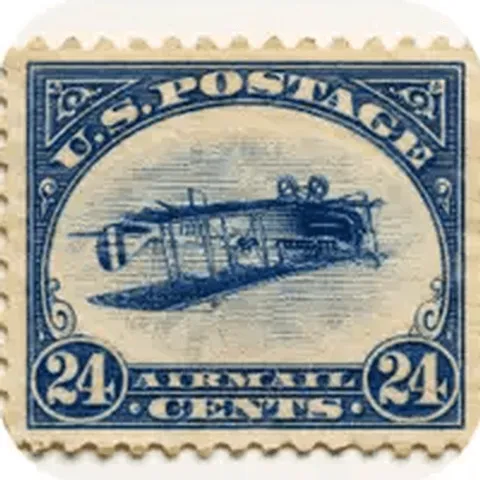
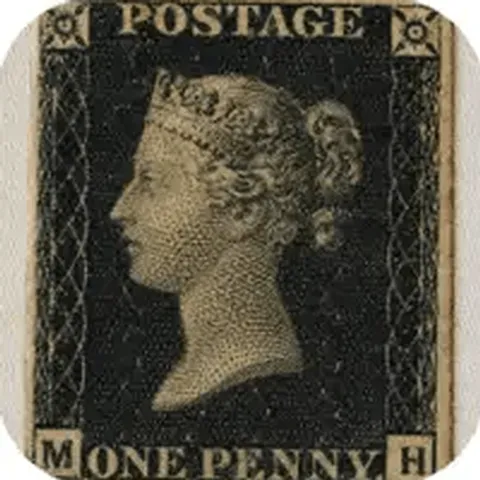
It is worth knowing what the real ceiling looks like, if only to calibrate expectations honestly, and for a fuller catalogue of the stamps at the very top of that ceiling, the rarest stamps in the world covers the whole list with survivor counts and record sales, from the one-of-a-kind British Guiana 1c magenta down. The Inverted Jenny, the 1918 airmail stamp printed with its biplane upside down, exists in exactly 100 recorded examples from a single sheet, and the finest known copy realised $2,006,000 at Robert A. Siegel Auction Galleries in November 2023 (realised auction). The Penny Black, the world’s first adhesive postage stamp from 1840, looks like it should be similarly rare and is not: roughly 1.3 million examples survive, and a typical used copy is an affordable stamp, not a fortune. The two sit at opposite ends of the same five categories above, one a genuine invert with a tiny surviving census, the other a common classic whose fame outran its scarcity. Real reference images for both are below, worth comparing against anything in your own album that claims to be either.
Running the checklist against your own album
The base rate, honestly stated: the great majority of album material fails every one of these five tests, and that is not a failure of your collection, it is the norm the entire hobby is built on. Modern commemoratives, heavily used definitives, and packet mixtures bought by weight belong to none of these categories, and no amount of looking will change that.
The point of a checklist like this one is speed. Working through five specific tests, rather than one vague sense that something “looks old”, eliminates the majority of any album in a single sitting and leaves you with a genuinely short list worth a second look. The American Philatelic Society’s own estate guidance makes the same point to collectors sorting an inherited collection: identify first, then decide what any of it is worth, because catalogue prices assume a grade of stamp your candidates may not actually be in.
Photographing the shortlist with Stampo gives you the country, year, denomination, and catalogue number for each one, plus an honest condition-tiered range rather than a hopeful headline figure, so the handful of stamps that survive this checklist get the attention they have actually earned.
The genuine articles
So you can compare against the real thing — these are genuine, public-domain reference images, not illustrations: