Every list of the rarest stamps in the world tells the same stories: the schoolboy’s find, the upside-down aeroplane, the auction records. What those lists never answer is the question that actually brought you here: could one of these be in the album in your attic? So this guide does both jobs. For each stamp you get the story and the numbers, and then the honest answer about the copy you might be holding, because reproductions of these stamps outnumber the originals by thousands to one.
The rarest stamps in the world are the British Guiana 1c magenta and Sweden’s Treskilling Yellow, with one known example each, the 1847 Mauritius Post Office pair, with about 26 to 27 known, and the Inverted Jenny, with 100 printed. Record sales run from about $2 million for a single stamp to over 10 million euros for a famous cover. Album copies are almost always reproductions.
The rarest stamps in the world, counted
| Stamp | Known examples | Record sale |
|---|---|---|
| British Guiana 1c magenta (1856) | 1 | $9,480,000 (Sotheby’s, 2014) |
| Treskilling Yellow (1855) | 1 | SFr 2,880,000 (last disclosed, 1996) |
| Mauritius “Post Office” 1d and 2d (1847) | ~26–27 | €10,027,800 for the “Ball cover” (2021) |
| Inverted Jenny (1918) | 100 | $2,006,000 for a single (2023) |
All figures are auction results including buyer’s premium where noted by the houses.
British Guiana 1c magenta: one stamp, four world records
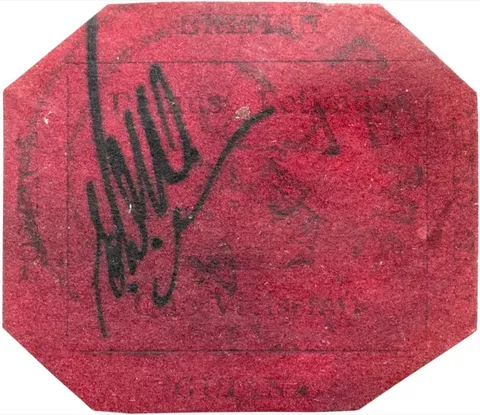
An emergency printing in 1856, run off by a Georgetown newspaper office when a stamp shipment from England was delayed. Exactly one example survives, found in 1873 by a 12-year-old schoolboy who sold it for a few shillings. It has broken the world-record price for a single stamp four separate times, peaking at $9,480,000 with premium at Sotheby’s in 2014, still the record. Stanley Gibbons bought it at Sotheby’s in 2021 for $8,307,000 and displays it at its London shop. The full story and figures are on our British Guiana 1c magenta page.
Could one be in your album? No, and this one is not even a probability statement: the single known example’s location is public. The most famous “second copy” ever claimed, in 1999, turned out to be an altered 4c stamp from the same 1856 issue. If you have an octagonal magenta stamp, it is a facsimile, most printed for books and exhibitions, and genuine period 4c provisionals are collectible in their own right and worth an expert look.
Treskilling Yellow: the colour that should not exist
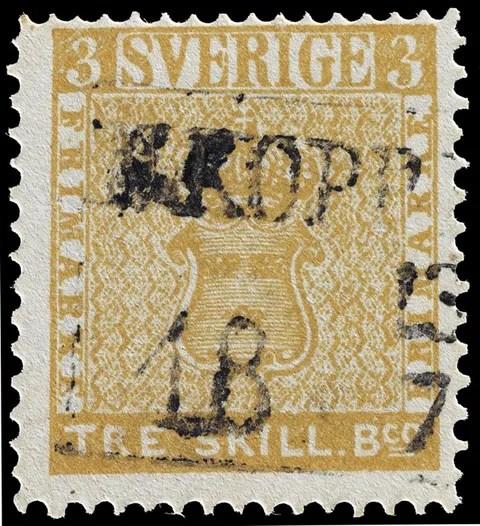
Sweden’s first three-skilling stamp of 1855 was printed in blue-green. One sheet position, almost certainly a wrong cliche inserted into the eight-skilling plate, was printed in that stamp’s yellow-orange instead. A single example is known, found by another schoolboy going through his grandmother’s papers in the mid-1880s (accounts differ between 1885 and 1886). Its last publicly disclosed price was SFr 2,880,000, about US$2.3 million, at David Feldman in 1996; later sales in 2010 and 2013 were private and undisclosed. Details on our Treskilling Yellow page.
Could one be in your album? Almost certainly not, but this is the one entry where checking is genuinely rational, because the test costs nothing: read the value line. A yellow-orange stamp reading ÅTTA SKILL. Bco is the normal eight-skilling, correct and common. One reading TRE SKILL. Bco is either sun-faded, chemically discoloured, a forgery, or the second example ever found. Every yellowish TRE examined since the 1880s has been one of the first three.
The Blue Mauritius: 500 printed, a dozen left
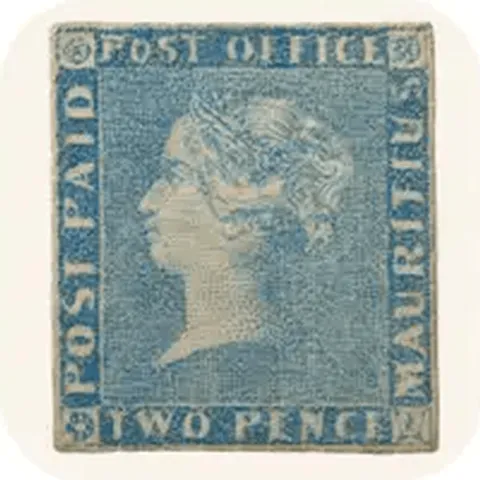
In 1847 Mauritius became the first British colony to print its own stamps: 500 each of a one penny orange-red and a two pence deep blue, engraved locally and inscribed POST OFFICE. About 26 to 27 survive in total, roughly 15 of the penny and a dozen of the two pence. In June 2021 the “Ball cover”, a penny stamp on an invitation to the governor’s wife’s fancy-dress ball, sold for €10,027,800 with premium at Christoph Gartner, the all-time record for any philatelic item. Both stamps are covered on our Blue Mauritius page.
Could one be in your album? Almost certainly not, and here is the 10-second check: the rarities read POST OFFICE down the left side. Mauritius’s follow-on issues, which are what albums actually contain, read POST PAID, and later printings of those are affordable classics. Nearly every genuine Post Office example is accounted for in museums and documented collections, and period forgeries are themselves over a century old, so any candidate needs expert certification before anyone will discuss it.
Inverted Jenny: one sheet of 100, tracked for a century
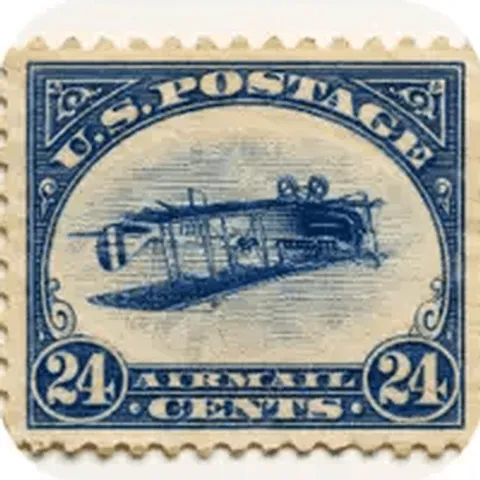
America’s contribution is a printing error: the 24-cent airmail of 1918 with the Curtiss Jenny biplane printed upside down. One sheet of 100 reached a post office window, bought by collector William Robey for face value, and no other sheet has ever surfaced. Each stamp’s position in that sheet is individually tracked in a published census (a few copies are lost or destroyed, including one stolen in the 1950s and never recovered), and the Smithsonian’s National Postal Museum holds several examples. Where all 100 ended up is a story in itself, and we follow the census through it in how many Inverted Jenny stamps exist. In November 2023 the finest known single sold for $2,006,000, a record for a single US stamp, covered by NPR among others. Our Inverted Jenny page has the tier-by-tier figures.
Could one be in your album? If it says 24 cents and the plane is upside down, check the census before your pulse rises: a genuine example must match a known position and provenance chain. The overwhelmingly likely answer is a reproduction, and one source of them is official: in 2013 the USPS deliberately reissued the design as a $2 souvenir stamp. The denomination is the instant tell, $2 means modern, and printed replicas of the 1918 original have been made for decades.
How to tell a reproduction at a glance
Across all four stamps, the same three checks settle most cases in a minute:
- Read the text. Denomination and inscription catch most reproductions instantly: $2 on a Jenny, POST PAID on a Mauritius, ÅTTA on a Swedish skilling.
- Look at the printing. Originals were engraved or carefully printed on period paper; flat, screened, poster-like printing means a modern facsimile, as does glossy or brilliant-white paper.
- Ask where it came from. Genuine examples of stamps this rare have published provenance chains. “It was in grandad’s album” is how reproductions arrive; original rarities arrive with paperwork.
There is a comfort in the honest answer. These stamps are famous precisely because nobody finds them, and meanwhile albums full of ordinary stamps do contain real, modest value in specific, findable places; that arithmetic is in why most stamps aren’t worth much. Even the famous Penny Black, the world’s first stamp, has 1.3 million survivors and an affordable price. Photograph any stamp that makes you wonder, and Stampo will tell you what it is and what tier it honestly belongs to, in seconds rather than decades of wondering.
The genuine articles
So you can compare against the real thing — these are genuine, public-domain reference images, not illustrations:
Sources
- British Guiana 1c magenta - Wikipedia
- The British Guiana One-Cent Black on Magenta ($8,307,000, 2021) - Sotheby's
- Treskilling Yellow - Wikipedia
- SWEDEN: 1855 The 'Treskilling' Yellow 3s Error of Colour - Museum of Philately
- Mauritius 'Post Office' stamps - Wikipedia
- Record result for the Mauritius Ball cover - Christoph Gartner (auction house)
- Inverted Jenny - Wikipedia
- Why a single 'Inverted Jenny' stamp sold for $2 million at auction - NPR
- Inverted Jenny - Smithsonian National Postal Museum
- Penny Black - Wikipedia