
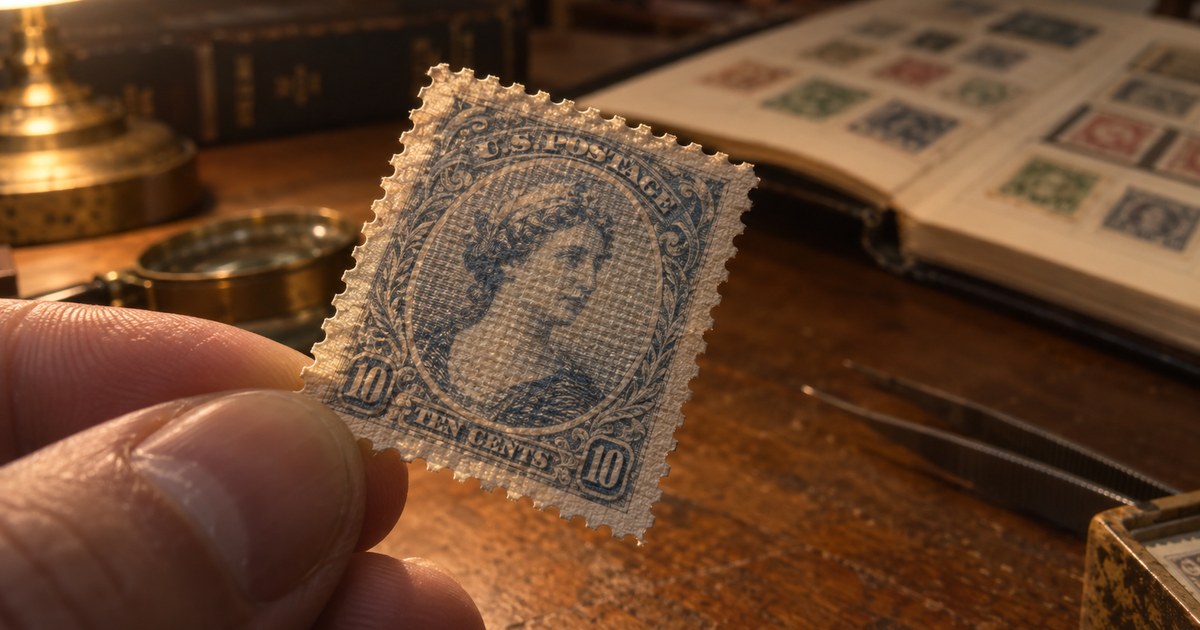
You have tilted an old American stamp under a lamp and found a faint waffle pattern pressed into the paper, and a search has told you that a stamp like that sold for millions. That is the moment almost every article about the Z grill stamp abandons the reader, because they are all written about the record price and none of them answer the next question, which is whether the waffle in your hand is the same waffle.
The Z grill stamp is the rarest United States stamp: two copies of the 1868 1c Franklin Z grill are recorded, and one sold for 4,366,000 dollars at Siegel Auction Galleries in June 2024. Almost every grilled American stamp is a common E or F grill instead, worth ordinary collector money rather than headline money. The grill family, not the grill, is what you are holding.
So this piece answers the practical question first. Grills came in roughly a dozen catalogued patterns, they were applied to hundreds of millions of stamps, and telling them apart is a measuring job rather than a recognition job.
What is a grill on a stamp, and why did the Post Office add one?
A grill is an embossed pattern of tiny pyramids pressed into the stamp paper, applied by a roller during production. The purpose was fraud prevention. In the 1860s the Post Office Department was worried about people washing cancellations off used stamps and posting them again, so breaking the paper fibres let the cancelling ink soak into the stamp rather than sitting on the surface, where soap and water could lift it off. Mystic Stamp Company adds a detail people forget: the inventor also argued the roughened surface would make stamps stick better.
The idea came from Charles F. Steel, a supervisor at the National Bank Note Company, who was granted a patent for the process in October 1867, as Linn’s Stamp News records in its account of the first production grill. Grilling then became standard on United States stamps for a few years before the whole scheme was quietly dropped in the early 1870s, once the fear of reuse faded.
The first attempt, catalogued as the A grill, covered the entire stamp. It worked too well: Wikipedia’s survey of grilling notes that it weakened the sheets so badly they tore during perforating and handling, so the company switched to a small rectangular patch of indentations. Every later grill is a variation on that patch, and the variations are what collectors catalogue.
What makes the Z grill different from the other grills?
Two things, and only one of them is visible without magnification.
The first is size and orientation. Grills are described by how many points they run across and down, and by whether the points project upward on the face of the stamp or downward. The A, B and C grills are points up. The D, Z, E and F grills are points down. Wikipedia lists the Z grill at 13 to 14 by 17 to 18 points, which overlaps closely with the dimensions given for the D and E grills either side of it, so measuring alone will not settle the question.
The second is the giveaway. The individual points of a Z grill carry horizontal ridges, where every other grill pattern shows vertical ridges or a crossed X pattern. That is the single diagnostic feature, and it is why the Z grill went unrecognised as a separate variety for decades. The lettering system itself was only introduced in the 1910s by the philatelist William L. Stevenson, long after the stamps were printed, which is why the letters run in a strange order rather than alphabetically by date.
Six denominations exist with the Z grill, catalogued by Scott as 85A through 85F: the 1c Franklin, 2c Jackson, 3c Washington, 10c Washington, 12c Washington and 15c Lincoln. The 2c, 3c and 12c were made first, in January 1868. The 1c, 10c and 15c followed in February and lasted barely any time at all, with roughly a thousand of each printed before production moved to the F grill. That short February run is the whole story of the rarity.
How rare is the 1c Z Grill, and what has it sold for?
Two copies of the 1c Franklin Z grill are recorded, both used. One belongs to the New York Public Library as part of the Benjamin K. Miller collection and has been exhibited at the Smithsonian’s National Postal Museum, which leaves exactly one in private hands. The 15c Lincoln Z grill is just as rare with two recorded, and the 10c Washington sits close behind with six.
The privately held 1c copy has a sale history that reads like a market history of American philately. Siegel Auction Galleries’ own published census for the stamp records it selling for 850,000 dollars at the 1998 sale of the Zoellner collection (realised auction), then trading in October 2005 to the investor Bill Gross in exchange for the unique Inverted Jenny plate number block, itself sold at Siegel that same month for 2.7 million dollars (realised auction). In June 2024 the Z grill came back to market in the William H. Gross Collection sale, and the same census records the result: sale 1323, lot 31, realised 4,366,000 dollars on June 14, 2024. That is a realised auction price for a unique object, not a valuation you can apply to a stamp on your desk.
Worth noting honestly: the 1c Z grill is usually called America’s rarest stamp, but Wikipedia’s grill survey points out that the 30c I grill currently has one recorded surviving copy, and that intensive study of the I grills began only recently. Rarity lists move. The Z grill’s fame is as much about its story as its census, and the other legends in that company are covered in our tour of the rarest stamps in the world.
Almost every grilled stamp is a common E or F grill
Here is the turn the record-price articles never make. Grilled stamps as a category are not rare at all. Mystic Stamp Company’s listing for the 1868 3c Washington with F grill, Scott 94, puts the estimated print run at 225,000,000 stamps. That is the single most likely thing for a grilled American stamp to be, by an enormous margin, because the 3c denomination paid the ordinary letter rate and the F grill was in production the longest.
Prices follow the supply. Linn’s Stamp News describes Scott 94 as the least expensive of the 1867 to 1875 grilled stamps and quotes the 2019 Scott Specialized Catalogue at 10 dollars used, 150 dollars unused without gum and 350 dollars with original gum (catalogue values, which sit above what a dealer pays and often above what a stamp actually fetches). A grilled stamp is a nice thing to own and a normal thing to own.
The 1c Franklin design compounds the confusion, because the ordinary blue 1c Franklin of that period is a common stamp in its own right, and we go through what those actually fetch in Benjamin Franklin 1-cent stamp value. Sharing a design with a famous rarity changes nothing about a stamp’s value.
How to work out which grill you have
Take these in order, and stop as soon as the answer is obvious.
Confirm there is a grill at all. Tilt the stamp under a single light source at a low angle and look across the surface rather than straight down. On a genuine grill the pattern is a rectangle of regular points, not a random crease or an album impression. Looking at the back often shows it more clearly than the front.
Check the date range. Grills belong to the 1867 to 1871 issues and a scattering of later ones. If your stamp is a twentieth century issue, the texture is something else.
Note points up or points down. Run a fingertip lightly over the face. Points up means the A, B or C grill, all of which are scarce. Points down covers the D, Z, E and F grills, which is where the common stamps live.
Measure the pattern. Count the points across and down within the grilled rectangle using a magnifier over a millimetre scale. This is what separates E from F and both from Z, and it is the step people skip.
Look at the ridges on the points. Horizontal ridges point to Z. Vertical or crossed ridges point to everything else. Use the same lighting discipline you would use for seeing a stamp watermark, because both jobs are about angle and patience rather than equipment.
Then stop. A grill identification of this consequence is not settled by a phone, by an app, or by a dealer’s eye across a counter. It is settled by a certificate from a recognised expertising body, which examines the stamp physically against reference material and issues a written opinion. Anyone who has genuinely found a Z grill will be told so on paper before any money changes hands, and the cost of that opinion is trivial against what is at stake.
The realistic next step
If the stamp in front of you is grilled, you own a piece of a real experiment in postal security, and that is worth knowing regardless of price. Start by identifying the stamp itself: photograph it with Stampo and the app will place the issue, year, denomination and catalogue number, then give an honest condition tiered range for the common varieties. That tells you within seconds whether you are looking at a routine 1860s classic or something that justifies the expense of a certificate.
For the wider picture of what is genuinely scarce among nineteenth century American issues, our United States stamp values guide works through it denomination by denomination. The odds are strongly that your waffle is an E or an F. That is not a letdown. It is a stamp that survived the Post Office trying to make sure nobody could use it twice.
Sources
- Z Grill - Wikipedia
- Grill (philately) - Wikipedia
- The Siegel Census - 1c Blue, Z Grill (Scott 85A)
- America's Rarest Stamp: the 1868 1c Z Grill - Mystic Stamp Discovery Center
- 94 - 1868 3c Washington, Red, F Grill, Perf. 12 - Mystic Stamp Company
- Look for United States George Washington F grill stamp - Linn's Stamp News
- Charles F. Steel developed first production grill for United States stamps - Linn's Stamp News
- 1-cent Z grill - Smithsonian National Postal Museum