
Most famous rarities come with fuzzy numbers: a few known here, an estimate there. The Inverted Jenny is different, and that is half its charm. If you are asking how many Inverted Jenny stamps are there, philately can give you an answer of unusual precision: one sheet, one hundred stamps, and a paper trail for every single one of them stretching back to 1918.
There are exactly 100 Inverted Jenny stamps. A single error sheet of 100 reached the public on May 14, 1918, when collector William T. Robey bought it for $24 at a Washington, D.C. post office. Each stamp’s sheet position is numbered and tracked, and every one of the 100 is accounted for in census records today.
“Accounted for” carries some fine print, and the fine print is where the best stories live. Here is the full ledger.
Why is there exactly one sheet of 100?
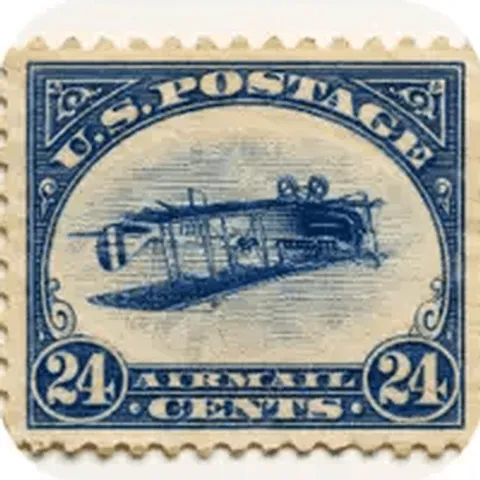
The 24-cent stamp of May 1918 was rushed out for America’s first regular airmail service, printed in two passes: one for the red frame, one for the blue Curtiss JN-4 biplane, the “Jenny”. Run a sheet through the second pass the wrong way round and the plane flies upside down. Inspectors caught and destroyed misprinted sheets at the Bureau of Engraving and Printing, and post office clerks were warned to watch for them. One pane of 100 slipped through to a post office counter anyway. No second pane has ever surfaced in more than a century, which is why the census of Inverted Jennys has a hard ceiling of 100.
Who found the sheet, and what did it cost?
William T. Robey, a Washington bank clerk and stamp collector, went to the post office on May 14, 1918 hoping for the new airmail issue. The clerk handed over a full sheet of inverts, and Robey later wrote that his heart stood still. He paid face value: $24 for the hundred stamps.
Postal inspectors spent the following days trying to recover the sheet, and Robey spent them dodging. Within a week he had sold it to Philadelphia dealer Eugene Klein for $15,000, and Klein promptly sold it on to the eccentric millionaire collector “Colonel” Edward H. R. Green for $20,000. Both figures are private-sale prices from 1918, and they mark the last time any Inverted Jenny changed hands cheaply.
Why does every Inverted Jenny have a position number?
Klein, managing the sheet for Green, did something quietly brilliant: before breaking the pane into singles and blocks, he pencilled each stamp’s sheet position, 1 through 100, on the back. That decision turned 100 identical-looking rarities into 100 individually traceable ones.
Position numbers are why the Inverted Jenny census works. Every auction appearance, theft, recovery, and museum donation attaches to a specific position, and specialist literature and auction houses maintain biographies for each stamp. When a copy surfaces, its pencil number and physical quirks tie it back to the sheet. A famous stamp you can serialise is a famous stamp you cannot easily fake or quietly launder, which matters for a rarity this valuable.
How many Inverted Jenny stamps are there today?
All 100 positions are accounted for in the sense that specialists can tell you the story of each one, though some have not been seen since their last sale, and the philatelic literature has long counted about seven as lost or destroyed through theft or mishandling. Depending on how you treat the missing and the damaged, that leaves roughly ninety-odd physical survivors, none of them pristine: even the finest copies carry Klein’s pencil numbers, and most show hinging, faults, or worse.
The casualties and near-misses are legendary in their own right:
- The locket copy (position 9). Colonel Green had one invert mounted in a gold locket facing a normal Jenny. It survived, but with a corner crease picked up behind the glass.
- The McCoy block (positions 65, 66, 75, 76). A block of four owned by collector Ethel McCoy was stolen from an exhibition in 1955. Two of the four were recovered years later, position 76 resurfaced in 2016, and position 66 is still missing today.
- Position 18. Stolen in 1977 and recovered in the early 1980s, its perforations trimmed off in an attempt to hide its identity.
That is what “accounted for” really means: not that all 100 sit safely in albums, but that each one has a documented fate, including the unlucky ones.
What is an Inverted Jenny worth now?
The benchmark is position 49, the finest known copy, graded 95 and one of the few with original never-hinged gum. Robert A. Siegel Auction Galleries sold it in November 2023 for $2,006,000 including the buyer’s premium, an auction record for the stamp, to collector Charles Hack, who had bought a different position for about $1 million in 2007. The same position 49 had sold for $1,593,000 at auction in 2018, and a plate block of four made $2,970,000 back in 2005. Those are auction realizations for the best material; typical singles, with faults or heavy hinging, trade lower, though still firmly in six figures. Our Inverted Jenny value page keeps the sourced price history.
Could you have an Inverted Jenny in your album?
Realistically, no, and the census is precisely why. With all 100 positions documented and any genuine copy traceable by its pencilled position number, an unknown Inverted Jenny turning up in a shoebox is effectively unheard of. What you might well have is the 2013 tribute: the US Postal Service reprinted the design as a $2 souvenir sheet, 2.2 million sheets of it, so upside-down Jennys from 2013 are common by design. The twist is that the USPS also slipped exactly 100 sheets with the plane flying right-side up into circulation as a deliberate rarity hunt, and one of those non-inverted sheets brought $51,750 at a 2014 auction.
So check the corner of the design: a “$2” means 2013, a “24” cents means 1918. Then photograph the stamp with Stampo for an honest identification either way. And if the census bug has bitten you, the Jenny is only one entry in the ledger of the rarest stamps in the world; for an airmail rarity your family might genuinely own, the Graf Zeppelin set is the better hunting ground, and our United States stamp value guide covers the everyday material the other 99.99 percent of albums hold.
The genuine article
So you can compare against the real thing — these are genuine, public-domain reference images, not illustrations: