
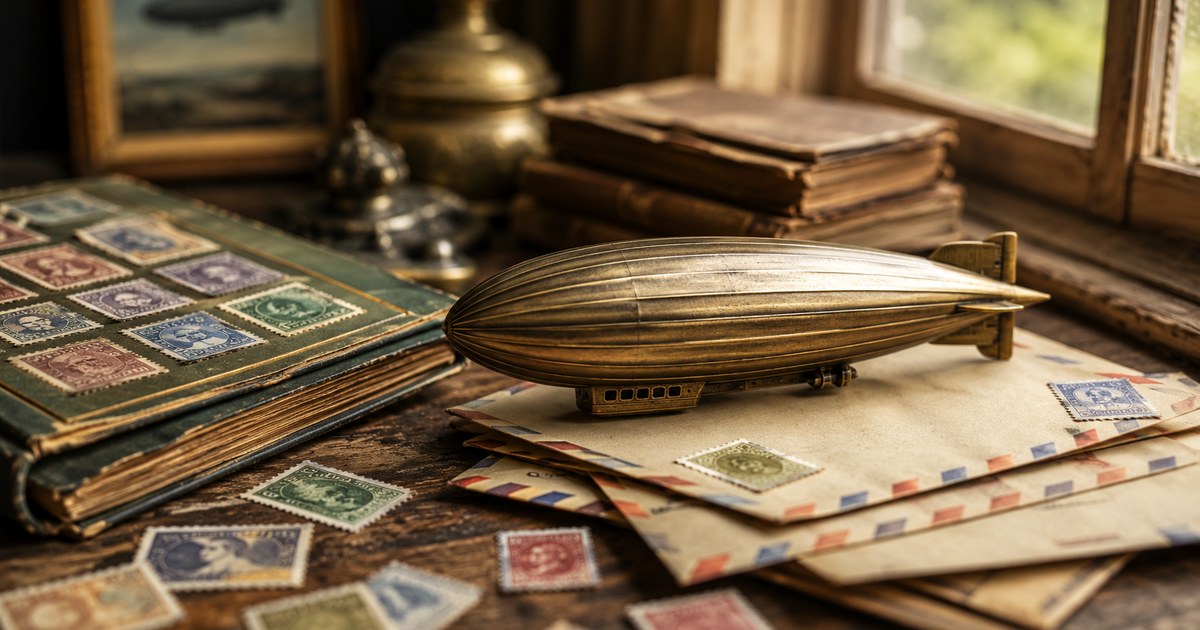
Most of this site exists to deliver honest bad news: the old stamps in your album are almost certainly common. Graf Zeppelin stamps are the exception collectors whisper about, and for once the whisper is true. If a 1930 United States Zeppelin airmail stamp is sitting in an inherited collection, it is one of the few finds that genuinely justifies a closer look.
The reason is brutal Depression economics. The 1930 Graf Zeppelin airmail set (Scott C13, C14 and C15) is valuable because roughly 93 percent of the printing was destroyed after collectors could not afford the $4.55 issue price in the first year of the Great Depression. Barely 227,000 of the three million printed were ever sold, and a complete set retails around $1,775 from dealers today.
That combination, a famous subject plus an accidentally tiny surviving supply, is exactly the survivor arithmetic we describe in why most stamps aren’t worth much. The Zeppelins simply landed on the right side of it.
Why are Graf Zeppelin stamps valuable when most old stamps are not?
In April 1930 the Post Office issued three large airmail stamps to prepay mail carried on the LZ 127 Graf Zeppelin’s Europe to Pan-America round flight. The airship was the technological celebrity of its age, a hydrogen-filled liner that had already circumnavigated the globe in 1929, and the stamps were printed in a run of one million of each value.
Then reality intervened. The set cost $4.55 at the post office counter, serious money months after the 1929 crash, and it could be used only for a narrow window of Zeppelin mail. Ordinary Americans had no use for it and collectors could not stretch to it. Sales were dismal, only about 7 percent of the printing, and when the sale period ended that summer the Post Office destroyed the unsold remainder. Roughly 227,000 stamps slipped into collections; the other 93 percent became pulp.
Compare that with the everyday stamps of the same era, printed in the billions and saved by everyone, and the price difference stops being mysterious. Scarcity was manufactured by a bad economy, one destruction order, and nothing else.
Which Graf Zeppelin stamp do you have?
Four US stamps carry the airship, and telling them apart takes one glance at the denomination printed on the face:
| Stamp | Denomination | Colour | Issued | What it shows |
|---|---|---|---|---|
| Scott C13 | 65¢ | Green | 1930 | The Graf Zeppelin over the Atlantic |
| Scott C14 | $1.30 | Brown | 1930 | The airship spanning the hemispheres |
| Scott C15 | $2.60 | Blue | 1930 | The airship passing a globe |
| Scott C18 | 50¢ | Green | 1933 | The “Baby Zeppelin,” issued for the Century of Progress flight |
The money is concentrated in the 1930 trio. The 1933 C18, nicknamed the Baby Zeppelin, was issued for the airship’s flight to the Chicago Century of Progress exposition after the worst of the destruction-driven scarcity story had already played out, and it survives in much friendlier numbers. It typically sells for a small fraction of the price of its 1930 siblings, which makes it the affordable way to own the design rather than a windfall. If your stamp says 50 cents, temper expectations accordingly; if it says $2.60, keep reading.
What is a set worth today?
The honest headline figure: a complete three-stamp 1930 set retails around $1,775 (Mystic Stamp Company’s current list price). Treat that as one major dealer’s retail ask for a collectible-quality set, not a guaranteed cheque, and as our US stamp values guide explains, selling prices run below retail.
Condition then stretches that figure in both directions, the same way it does for every classic stamp:
- Never hinged mint examples, with pristine original gum that has never carried a stamp hinge, sit at the top of the market and command a substantial premium.
- Hinged mint examples, the most common way collectors of the era mounted stamps, sell at a meaningful discount to never hinged.
- Used examples were mostly used on actual Zeppelin mail, so a genuinely used stamp, and especially one still on its flown cover, is its own collectible story.
- Faults (creases, thins, missing perforations, stains) drag any of the above down sharply. Centring matters too: a design sitting crooked in its margins is worth far less than a well-centred example of the same stamp.
We deliberately do not publish a per-tier dollar table here, because per-condition prices for these stamps move with the auction market and quoting stale numbers would break our own honesty rules. The reliable facts are the survivor count, the retail benchmark for a set, and the direction condition pushes from there. For a specific stamp, get a current identification and range first, then a dealer or auction estimate.
Flown Zeppelin covers: a market of their own
The stamps were made to carry mail, and the envelopes that actually flew are collected at least as eagerly as the stamps themselves. Zeppelin mail from the 1930 Pan-American flight and the airship’s other voyages carries distinctive flight cachets and postmarks, and specialists collect it by route and leg. A C13, C14 or C15 on a genuine flown cover is a piece of postal history, and the cover can be worth more than the soaked-off stamp would be.
Which leads to the standing rule that applies across all of philately: never soak a stamp off an old envelope. On a Zeppelin cover you would be destroying the more valuable object to rescue the less valuable one.
The warnings that come with real money
Wherever a mint-condition premium exists, so does an industry of faking it:
- Regumming. Because never-hinged gum carries a premium, worn examples get coated with fresh gum to imitate it. Regummed stamps are worth hinged prices at best, and detecting regumming is genuinely expert work.
- Faked cancels and cachets. Flight markings have been counterfeited to turn ordinary covers into “flown” ones.
- Condition optimism. Sellers describe hinged stamps as never hinged more often than the reverse.
The defence is the same at every level of the hobby: for a purchase or sale at Zeppelin prices, insist on a certificate from a recognised expertising body (the Philatelic Foundation, the American Philatelic Society’s expertising service, or equivalent). The certificate typically costs a small fraction of the stamp’s value and settles the questions that actually set the price.
If you think you have one
Photograph the stamp and confirm what it is before anything else: denomination, colour and design place it as C13, C14, C15 or C18 in seconds, and an honest first-pass range follows from condition. The Zeppelins earn their place beside the legends in our tour of the rarest stamps in the world for the best reason there is: the value is real, documented and checkable. That is rarer than the stamps.