
Almost every British album contains at least one Penny Red, which is exactly the problem. Penny Red stamp value is a story of two numbers: about 21 billion printed, and around five surviving used examples of one famous printing plate. Everything you read about this stamp lives between those two facts, and most articles quote the exciting number without the honest one.
Most Penny Red stamps are worth 10p to 30p at dealer retail, because about 21 billion were printed between 1841 and 1879. Value depends on which type you own: 1841 imperforates with four margins, scarce plates, and mint examples are worth more, and the famous Plate 77 has sold for £495,000 to £550,000.
So the useful question is not “is a Penny Red valuable” but “which Penny Red do I have”. Here is how to place yours in about two minutes, no catalogue required.
First, confirm it is a Penny Red
The design is the same Queen Victoria profile as the Penny Black, and colour is the quick tell: black stamp, 1840 to 1841; red or red-brown stamp, 1841 onward. The switch happened because the red cancellation used on the Penny Black was hard to see and could be cleaned off; a black cancel on a red stamp showed plainly and stayed put. If yours is black, you want our Penny Black checks instead.
Which of the three Penny Red types do you have?
The Penny Red ran for 38 years, and the design changed twice in ways you can see without a magnifier.
1. No perforations at all (1841 to 1854). The earliest Penny Reds were cut from the sheet with scissors, so the edges are straight or slightly ragged, never machine-punched. These imperforates sell for roughly 50p–£5 in good used condition per Warwick & Warwick, and, as with the Penny Black, the price lever is margins: four clear, even margins earn the top of the range, a design cut into sits at the bottom. Mint examples with original gum are genuinely scarce and deserve a specialist look.
2. Perforated, stars in the top corners (1850s to 1864). Perforation arrived in the 1850s, first gauge 16, then gauge 14 from 1855. These “stars” issues carry small star ornaments in the upper corners and check letters only in the bottom two corners. Collectible used examples run about 30p–£10 per Warwick & Warwick, with the better money in scarcer perforation and watermark combinations and in clear, light cancellations.
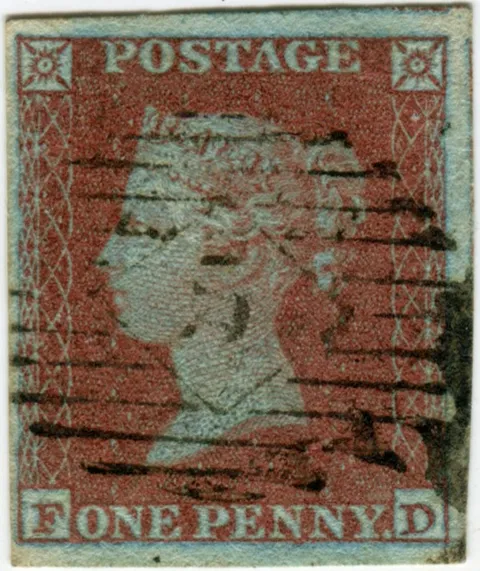
3. Perforated, letters in all four corners (1864 to 1879). The workhorse. From 1864 the stars were replaced by check letters in all four corners, and the plate number was woven into the engine-turned pattern at the left and right of the design. These are the Penny Reds that exist in enormous quantities, and typical used copies are the 10p to 30p tier. This is, statistically, the one you are holding.
How do you read a Penny Red plate number?
On the 1864 to 1879 type, look at the lacework immediately left and right of the portrait, about halfway up. A small number, from 71 to 225, is hidden in the pattern on each side. It usually takes a magnifier, decent light, and a little patience, and a photograph you can zoom into beats squinting at the stamp itself.
More than 400 plates printed Penny Reds over the stamp’s life, and nearly every plate number you can find is common. Warwick & Warwick’s guide is blunt about this: plate hunting is a pleasure, not a pension. The single exception is the reason anyone bothers.
What actually happened with Plate 77?
Printing plate 77, made in 1863, was rejected because its alignment was not up to standard: its stamps would not sit correctly under the perforating machine. The plate was defaced and its output was supposed to be destroyed, but a few stamps, probably from the testing process, slipped out. Those survivors became the most famous rarities in British philately. The count usually cited is around five used examples; specialist censuses that include lost and institutional copies record a few more.
The two modern sales tell you what that scarcity means. One example sold in 2012 for £550,000, described by the auction house Spink as a record for a British stamp. Another of the known used copies sold for £495,000 through Stanley Gibbons in March 2016, a sale covered by both Linn’s Stamp News and CNBC.
Now the honest odds. Out of roughly 21 billion Penny Reds, the Plate 77 survivors number in the single digits, and their whereabouts are largely documented. Forgers have altered other plates for over a century, most commonly shaving Plate 177 down to read 77. So if your stamp appears to read 77: photograph it, compare the check letters and condition carefully, and understand that any genuine claim requires a certificate from a recognised expert body such as the RPSL or BPA. Every Plate 77 that matters to the market has one.
What genuinely lifts Penny Red value?
Setting the lottery ticket aside, here is where real, repeatable premiums live:
| Feature | Why it pays |
|---|---|
| 1841 imperforates with four margins | Scarce in fine condition; margins multiply price |
| Scarcer plates and varieties | Some stars and plate issues are legitimately harder to find |
| Mint with original gum | The vast majority of survivors are used |
| Stamps on original covers | Postal history can be worth more than the stamp |
| Clear, unusual cancellations | Collected in their own right |
Condition rules every tier: centring, cancellation weight, tears, thins, and creases decide where a stamp lands within its range. A damaged example of a better variety is often worth less than a superb example of a common one, a theme we cover more broadly in why most stamps aren’t worth much.
The two-minute verdict
Check the colour, check the corners, read the plate number if there is one, and be honest with yourself about condition. Nine hundred ninety-nine times in a thousand the answer is a pleasant, common stamp from the 10p to £10 tiers, and knowing that in two minutes beats wondering for years. Our full, sourced price breakdown lives on the Penny Red value page, alongside the rest of our Great Britain stamp values guide. Or photograph the stamp and let Stampo place it for you, plate number, tier, and all.
The genuine article
So you can compare against the real thing — these are genuine, public-domain reference images, not illustrations:
Sources
- Penny Red - Wikipedia
- The COMPLETE Penny Reds stamp guide - Warwick & Warwick
- Extremely rare Penny Red stamp sells for £495,000 - Linn's Stamp News
- Penny stamp sells for more than $700,000 - CNBC
- Is my Penny Red worth millions? - Armchair Philately
- Plate 77 Feature - Spink
- Plate 77 - The Penny Red Collector