
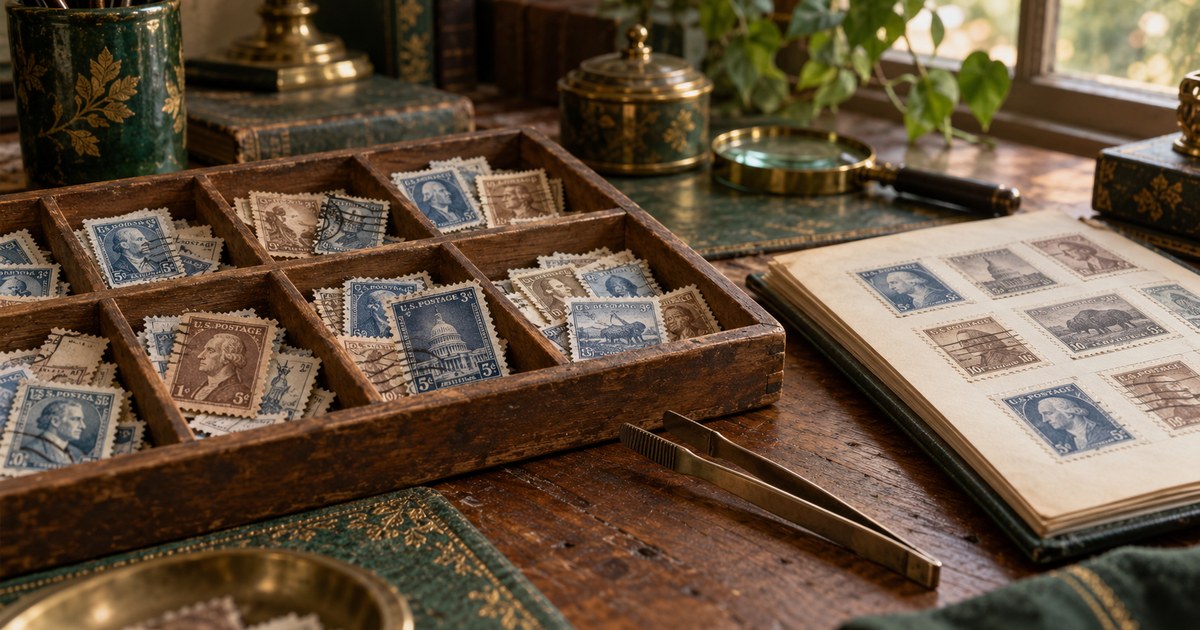
Five cent stamps turn up in almost every inherited American album, usually by the page rather than the copy, and the person holding the album wants one number back. There is no one number. The 5 cent stamp value question covers roughly 130 years of United States postage, from the first stamp the country ever issued in 1847 to the blue Washingtons still being soaked off envelopes in the early 1970s, and the two ends of that range have nothing in common except the denomination printed on them.
Most 5 cent stamps are worth a few cents. The denomination ran from 1847 into the 1970s, and the twentieth century issues that fill American albums are extremely common: Mystic Stamp Company lists the 1966 5c Washington at 45 cents (dealer retail). Only stamps from the 1847 to 1868 band are genuinely scarce, and those look and feel different from the rest.
Nearly every page that ranks for this question answers it for one stamp, usually that 1966 Washington, and leaves the other few dozen 5 cent issues unexplained. Sorting by era fixes that, because the era decides which band you are in before condition, centring or cancel matter at all.
Why the 5 cent stamp value question has no single answer
The denomination kept reappearing because it kept landing on a real postal rate. In 1847 five cents prepaid a half ounce letter travelling up to 300 miles. More than a century later it came back around: the United States Postal Service’s official rate table shows first class letter postage sitting at five cents from January 7, 1963 to January 7, 1968.
That second window is the reason your album is full of them. For five years every letter in America needed a five cent stamp, so the Post Office Department printed the definitive in vast quantities and released dozens of five cent commemoratives alongside it. The 1847 stamp, by contrast, was printed in the low millions and then withdrawn.
Three bands follow from that, and they are worth holding in your head as separate markets:
- 1847 to the late 1860s. Small print runs, imperforate or grilled paper, the only band where scarcity is the normal condition rather than the exception.
- 1870s to the 1930s. Bureau definitives and commemoratives. Real collector interest, modest money, with the value concentrated in errors and varieties rather than in the ordinary stamps.
- 1930s to the 1970s. Face value or less. This is where almost every 5 cent stamp in circulation today belongs.
What is a mid-century 5 cent stamp worth?
Cents, and that is the honest default for the overwhelming majority of them. Mystic Stamp Company’s listing price for the 1966 5c Washington from the Prominent Americans series is 45 cents (dealer retail). The 1954 5c James Monroe from the Liberty series lists at 50 cents (dealer retail) at the same dealer. Those are asking prices from one of the largest stamp dealers in the country, which means a dealer buying yours pays a fraction of them.
The commemoratives from the 1963 to 1968 rate window behave the same way. There are a great many of them, they were bought by the sheet by people who expected them to appreciate, and that expectation is exactly why they did not. The stamps on the facing pages of your album follow the same arithmetic, and we work through the neighbouring denominations in 3-cent stamp value and 4-cent Lincoln stamp value.
One specific case deserves a straight answer, because it comes up constantly. An unused sheet of 1960s 5 cent stamps is worth its postage. United States stamps issued from 1861 onward remain valid on mail, as Wikipedia’s account of postage stamp demonetization sets out, so a full pane of one hundred 5 cent stamps is five dollars of postage you can actually spend. Intact sheets carry a small collector premium over that floor in dealer stock, but the floor is where they trade.
The middle band: 1870s to 1930s definitives
Between those extremes sit the 5 cent Taylors, Grants, Lincolns, the blue Washington heads of the Washington-Franklin era and the 1922 series Theodore Roosevelt. These are the stamps people are most often surprised by in both directions. They are old enough to look important and common enough that ordinary used copies still trade for small money.
The real value in this band lives in errors. The best known 5 cent error is a printing accident from 1917: a 5 cent die was entered by mistake into a plate of 2 cent stamps, so a small number of red 5 cent Washingtons were printed in the middle of sheets of red 2 cent stamps. Mystic lists the perforated 10 version, Scott 467, at 995 dollars (dealer retail); a second perforation variety, Scott 505, exists from the same accident. These are identifiable without a catalogue, because the stamp is the wrong colour for its denomination: a 5 cent stamp printed in the carmine of the 2 cent issue rather than blue.
Which 5 cent stamps are genuinely scarce?
The first one. The 1847 5c Franklin, Scott 1, was one of the two stamps that opened American postage, issued July 1, 1847 in a run Mystic Stamp Company puts at roughly 3,600,000, and it is imperforate because perforating machines had not reached the United States yet. Mystic’s listing price is 4,750 dollars (dealer retail), varying by which condition option a buyer takes.
The 1856 5c Jefferson and the 1861 5c buff Jefferson sit behind it, scarce rather than legendary. And there is one genuine 5 cent rarity most people have never heard of: Wikipedia’s survey of grilled United States stamps records just four surviving copies of the 5 cent A grill, from the brief 1867 experiment in embossing stamps so cancelling ink could not be washed off.
That is the whole scarce list. If your stamp is not from this band, the era has already answered the value question.
Four checks that place your stamp in a band
Work through them in order, because each one narrows the field faster than searching a description ever will.
Perforations. Straight, uncut edges with no perforation holes point to the 1847 to 1856 window, or to a reprint. Perforated edges mean 1857 or later on a normal issue.
Grill. Tilt the stamp under a lamp and look for a small waffle pattern of tiny raised points embossed into the paper. That marks the 1867 to 1871 window and moves the stamp into the classic band immediately.
Watermark. Hold the stamp face down in a shallow tray of watermark fluid and look for the letters USPS worked into the paper. Watermarked paper places a Washington-Franklin era stamp in the middle band and separates varieties that look identical dry.
Cancel versus reprint. This is the check that saves the most disappointment. The 1847 design was reproduced twice. The 1875 reproduction, Scott 3, was never valid for postage and lists at 1,495 dollars (dealer retail) at Mystic. Far more common is the 1947 CIPEX souvenir sheet, Scott 948, which reprinted both 1847 designs for the stamp centenary and lists at 1.25 dollars (dealer retail, Mystic Stamp Company). If your Franklin came out of a mid-century album with clean modern paper and no period cancel, the souvenir sheet is the likely answer.
What to do with the page in front of you
Sort the page by era before you value anything. Pull out the imperforate and grilled stamps, set aside anything printed in an obviously wrong colour for its denomination, and treat everything from the 1930s onward as face value stock unless something specific says otherwise.
For the ones you cannot place, photograph the stamp with Stampo instead of typing a description into a search box. The app identifies the issue, the year and the catalogue number, then gives an honest condition tiered range rather than a seller’s asking price. Our United States stamp values guide covers what is genuinely scarce across the rest of the country’s issues, denomination by denomination.
The verdict on the 5 cent stamps in your album: nearly all of them are common, most of them are still spendable postage, and the handful that are not will announce themselves through their edges and their paper long before their price.
Sources
- Rates for Domestic Letters Since 1863 - United States Postal Service
- 1283 - 1966 5c Prominent Americans: George Washington - Mystic Stamp Company
- 1038 - 1954 5c Liberty Series: James Monroe - Mystic Stamp Company
- 467 - 1916 5c Washington, Carmine, Unwatermarked, Perf. 10, Color Error - Mystic Stamp Company
- 1 - 1847 5c Benjamin Franklin, Red Brown, Thin Bluish Wove Paper, Imperf. - Mystic Stamp Company
- 3 - 1875 5c Franklin, Red Brown, Imperf. - Mystic Stamp Company
- 948 - 1947 CIPEX Souvenir Sheet - Mystic Stamp Company
- Postage stamp demonetization - Wikipedia
- Grill (philately) - Wikipedia