
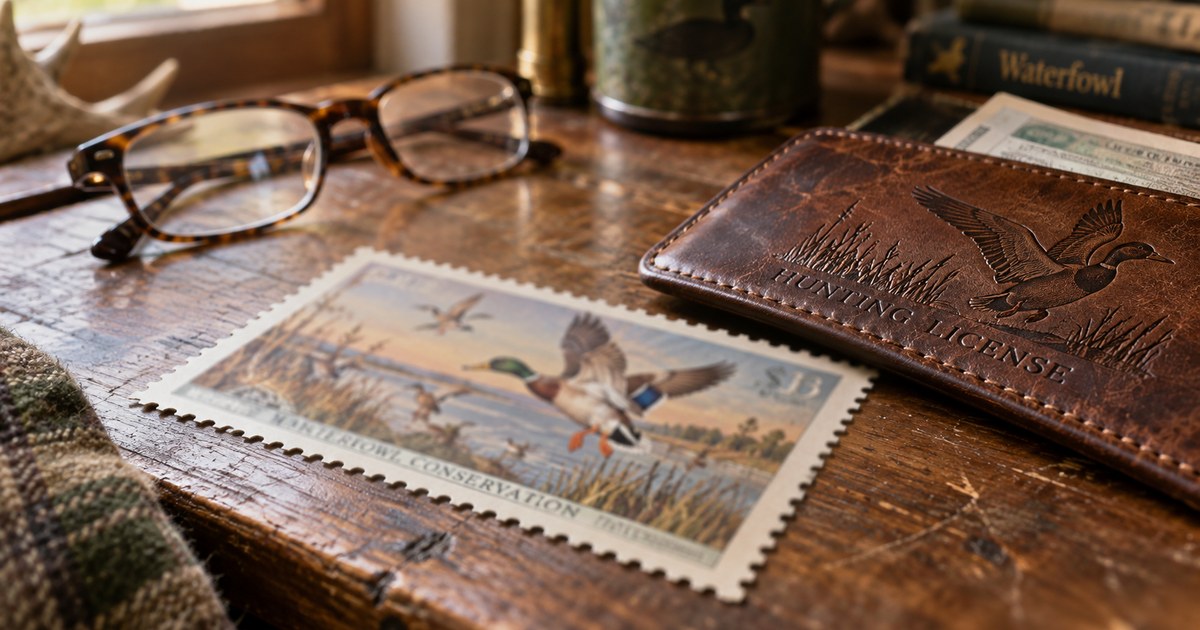
The duck stamp in front of you is probably large, beautifully engraved, and has somebody’s name written across the ducks in ballpoint. Every price list you can find will quote a duck stamp value without mentioning that signature, which is unfortunate, because on this one series of stamps the signature is the single biggest thing standing between the number on the screen and the number in your hand.
Most federal duck stamps are worth from a few dollars to a few hundred, and the deciding factor is the hunter’s signature. The dealer Mystic Stamp Company retails a mint 1934 RW1 at $675 and a used one with small flaws at $110, both dealer-retail asking prices. Modern issues sit far lower.
The reason is simple once you know what these things were for. A federal duck stamp was never a postage stamp. It was a licence.
Why is a duck stamp different from an ordinary stamp?
In 1934 President Franklin D. Roosevelt signed the Migratory Bird Hunting Stamp Act, and the U.S. Fish and Wildlife Service has issued a stamp under it every year since. Officially it is the Migratory Bird Hunting and Conservation Stamp. The Service states that all waterfowl hunters 16 years of age and over must annually buy and carry one, and that the current price is $25, a level set beginning with the 2015-2016 season. The first stamp, designed by Jay N. “Ding” Darling, cost $1.
The money is the point of the programme rather than a side effect. The Fish and Wildlife Service states that some $1.3 billion has gone into the fund since 1934, helping protect more than 6 million acres of wetland habitat. The Service adds a benefit collectors often miss: a current federal duck stamp is a free pass into any national wildlife refuge that charges an entry fee.
Because these are revenue stamps rather than postage, Scott lists them in a separate series prefixed RW. RW1 is the 1934 issue, and the numbering runs forward one per year, which makes identifying a duck stamp far easier than identifying most of what sits in an inherited album. The year is usually printed on the stamp.
The signature rule that decides most duck stamp values
Here is the part the price lists leave out. A federal duck stamp is only valid as a hunting licence once the hunter has signed it. The Missouri Department of Conservation states the federal requirement plainly: to be valid, the physical federal duck stamp must be signed in ink across the face.
Across the face. Not on the back, not in a margin. Directly over the artwork.
Nearly every duck stamp that was actually used for its intended purpose therefore carries a name written across the ducks, and those are the ones that survive in drawers, wallets and old licence folders. Collectors, meanwhile, want the stamp unsigned, unhinged and with full original gum, which is the state a stamp only reaches if nobody ever hunted with it. Early duck stamps were not even sold to collectors at first; Mystic notes that the 1934 issue was placed on sale for stamp enthusiasts only fifteen days before the first stamps expired.
So the ordinary logic of used stamps does not transfer here. On a postage stamp a cancel is expected and a used copy is a legitimate collecting category, as we cover in are used stamps worth anything. On a duck stamp, “used” means somebody wrote on it.
The price effect is large and easy to see in a dealer’s own list. For the 1962 RW29 pintail drakes, Mystic’s dealer-retail asking prices run $17 for a used example with small flaws and $125 for a mint one. For the 1934 RW1, the same comparison is $110 used against $675 mint. A signature is not a small deduction on a duck stamp. It moves the stamp into a different price bracket.
What are federal duck stamps actually worth?
Three reference points, all dealer-retail asking prices from Mystic Stamp Company, checked in September 2026. Dealer-retail is what a shop charges, not what it pays you, so treat these as the ceiling of what your copy could be worth rather than an offer.
- RW1, 1934, $1 face. Used with small flaws, $110. Mint, $675. Mint Very Fine Never Hinged, $1,150. This is the top of the series and the one most people are hoping for.
- RW29, 1962, $3 face. Used with small flaws, $17. Mint, $125. Mint Very Fine Never Hinged, $165. Mystic also lists the stamp still affixed to its hunting licence at $28.75, which is worth knowing before anyone soaks one off.
- RW87, 2020, $25 face. Used single, $52. Mint, $69. A modern duck stamp does hold value at retail because print runs are small next to ordinary commemoratives, but the gap between $25 face and a $69 asking price leaves very little room once a dealer’s own margin is taken out.
The honest default for a drawer find is the middle and modern end of that range, not the top. The pre-war issues are the scarce ones; anything from the 1970s onward exists in quantity, and a signed used copy of a recent year is worth a few dollars at most to a buyer who already has one. If your stamps are US material more broadly, the same reasoning across the whole country is set out on our United States stamp value page.
Why gum and centering matter more here than usual
Because the collected condition for this series is mint never hinged, the two things that ruin gum are the two things that most often happen to duck stamps.
The stamps are physically large, which means a hinge mark, a bend or a gum crease shows immediately and there is more surface for a plate to sit off-centre. And the mint copies that survive were frequently stored loose in albums of the period, where hinging was standard practice. A hinged mint duck stamp is a normal, collectable stamp. A never hinged one is a different price tier, which is exactly why Mystic prices RW29 at $125 mint and $165 mint never hinged, and RW1 at $675 against $1,150. If the never hinged distinction is new to you, what mint never hinged means explains what to look for on the back.
Two practical rules follow. Do not soak a duck stamp off a licence, because the licence is often worth more than the loose stamp. And do not try to remove a hinge remnant or improve the gum, because a disturbed-gum stamp is worth less than an honestly hinged one.
Are state duck stamps worth anything?
Usually much less, and it is worth checking which kind you have before getting excited. Most states run their own waterfowl stamp programmes, and in most of them hunters buy both a federal and a state stamp. Some states issue separate collector and hunter versions of the same design, and a few issue signed governor’s editions in limited numbers.
The price difference is stark. Mystic retails a 1995 Pennsylvania state duck stamp at $4.50, dealer-retail, against $69 for the 2020 federal issue. State duck stamps are attractive, genuinely collected, and almost never the item that changes what a collection is worth. If a stamp says the name of a state rather than “Migratory Bird Hunting and Conservation Stamp”, you are looking at the cheaper category.
How to check the duck stamp in front of you
Work in this order. Read the year printed on the stamp and convert it to an RW number by counting from 1934. Turn the stamp over and decide whether there is full undisturbed gum, a hinge mark, or no gum at all. Then turn it back and look for a signature across the face. Those three answers, in that order, put your stamp within one bracket of the correct figure before you ask anybody anything.
Stampo does the first two steps from a photograph. Point it at the stamp and it identifies the issue and its catalogue number, then gives a value range tiered by condition rather than one flattering headline number, so you know whether the copy in your hand is the $17 version or the $1,150 version before you go looking for a buyer.
Sources
- Federal Duck Stamp | About Us - U.S. Fish & Wildlife Service
- Duck Stamps - U.S. Fish & Wildlife Service
- Federal Duck Stamp - Missouri Department of Conservation
- Federal Duck Stamp - Wikipedia
- RW1 - 1934 $1.00 Federal Duck Stamp, Mallards - Mystic Stamp Company
- RW29 - 1962 $3.00 Federal Duck Stamp, Pintail Drakes - Mystic Stamp Company
- RW87 - 2020 $25.00 Federal Duck Stamp, Black-Bellied Whistling Duck - Mystic Stamp Company
- SDPA13 - 1995 Pennsylvania State Duck Stamp - Mystic Stamp Company
- Duck Stamps - Mystic Stamp Discovery Center