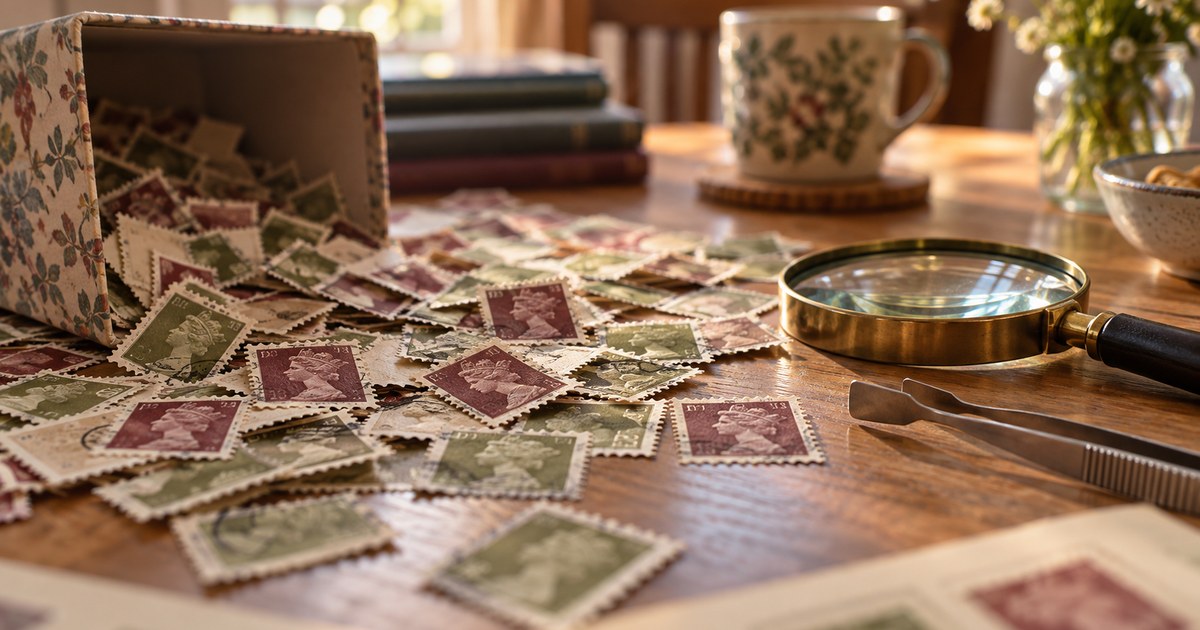
Almost every British household that kept anything at all kept some stamps with the Queen’s head on them, which is why Queen Elizabeth stamp value is one of the questions we hear most often and one of the hardest to answer optimistically. The shoebox, the tin, the loose-leaf album from the 1980s: they are full of small profiles in olive, maroon and blue, and the sheer familiarity of the design makes people assume that fifty years of history must be worth something.
A Queen Elizabeth stamp is almost always worth very little. The Machin definitive ran from 1967 to 2022 and was printed in such volume that used examples are traded by the kilogram rather than one at a time. Genuine value inside the reign sits in specialist varieties, documented errors and a handful of high denominations, all of which need verification before any figure means anything.
That is the uncomfortable part. The useful part is that the reign is unusually easy to sort, because the material divides cleanly into three bands, and you can put almost everything in your box into one of them in an evening.
Why is Queen Elizabeth stamp value usually so low?
Scale. The Machin definitive, the plain sculpted profile with a denomination and nothing else, was introduced on 5 June 1967 and ran until its final issue on 4 April 2022, four months before the Queen died. That is the working postage of an entire country for fifty-five years. Wikipedia’s account of the series notes that it produced well over five thousand collectable varieties of colour, value, gum, phosphor banding, overprints, perforations and printing method, which tells you how much material exists to sort through and how fine the distinctions between the collectable ones are.
The market prices ordinary used Machins accordingly. They are sold as kiloware, which means by weight, still on paper or soaked off it. The UK dealer Stamp Shop prices one-kilogram bags of mixed used stamps at roughly £17 to £32.50 depending on origin, and those are dealer-retail asking prices for thousands of stamps at once. Nobody is pricing them individually because individually there is no price to quote. This is the same base rate that governs most twentieth-century material anywhere, for the reasons set out in why most stamps aren’t worth much.
If your box is loose used definitives off envelopes, that is what you have. It is not a disappointing collection. It is the normal one.
Which Queen Elizabeth stamps do you actually have?
Sort the box into three piles before you look up anything.
- Used Machins, 1967 to 2022. Small, one colour, a profile facing left, a denomination, no country name. Cancelled with a postmark. This is the bulk pile and it is the kiloware pile.
- Unused Machins and unused commemoratives. Full gum on the back, no postmark. These have a floor, but it is a postage floor rather than a collector one, and the rules changed recently. More on that below.
- Pre-decimal material, 1952 to 1971. Denominations in shillings and pence rather than p. This includes the Wilding definitives, which came first.
The Wildings are the series before the Machins: definitives showing the Dorothy Wilding photographic portrait of the Queen, in use from December 1952 until decimalisation in 1971 and replaced as the main design by the Machin head in 1967. They matter here because they carry identifying features the Machins do not. Wikipedia records three successive watermarks (Tudor crown with E2R, St Edward’s crown with E2R, then St Edward’s crown alone) and an experimental run from 1957 with graphite lines printed on the back, the only British stamps ever to have them. Those features separate cheap Wildings from scarce ones, and they are exactly the kind of thing a casual sorter misses.
Whether a used stamp carries a heavy or a light cancel changes its price within all of these bands, which is the subject of whether used stamps are worth anything.
Where does genuine value sit in Queen Elizabeth II stamps?
In narrow, specialist categories, and every one of them is a category you should assume you do not have until an expert says otherwise. Blackheath Stamps, a UK dealer, sets out the same shortlist in its guide to the most valuable QEII stamps: early Wilding definitives and their watermark and graphite-line varieties, scarce printings, booklet panes, and genuine Machin errors such as missing colours, missing or misplaced phosphor and wrong colours. Its warning is the important half of the sentence: modern errors are faked and are easily mistaken for ordinary production variation, so authenticity, not appearance, decides the value.
Two sourced figures give the honest shape of that market.
At the everyday specialist end, the dealer Stamps For Sale lists decimal Machin missing-phosphor errors in a range of roughly £8.25 to £18.75 each. Those are dealer-retail asking prices for verified varieties, not offers anyone would make you, and they are what a real, catalogued Machin error is worth in most cases. Tens of pounds, not thousands.
At the far end, Warwick & Warwick records a 1967 Discoveries 1s9d with the gold Queen’s head missing that realised £23,600 including buyer’s premium at auction in December 2014. That is a realised auction price for a single documented missing-colour error on a commemorative, described at the time as the most important modern British stamp sold this century. It is the ceiling of the QEII error market, not a benchmark for anything in a shoebox.
The other place value concentrates is the tall high-value Machins. Wikipedia’s series history describes three separate high-value formats: the larger square 1969 issue carrying 2s6d, 5s, 10s and £1, the decimal 10p to 50p values from 1970, and the taller portrait format from 1977 that ran from £1 to £5. Later high values carried Iriodin iridescent ink specifically to defeat photocopying. Mint high values are collected as mint never hinged, so the gum question decides most of the price, and we cover how much a hinge costs in what mint never hinged means.
One more genuinely interesting corner, and a nod to where the whole story starts: the 1990 Double-Head Machins put Queen Victoria’s profile alongside the Queen’s to mark 150 years of British stamps, counting from the Penny Black. They are a curiosity rather than a windfall.
Are unused Queen Elizabeth stamps still valid postage?
Not the ordinary definitives, and this is the single change that surprises people sorting an old drawer. Royal Mail replaced its everyday definitives with barcoded versions, and as the ABPS reported, non-barcoded definitive stamps stopped being accepted as postage after 31 July 2023, after an extension from the original deadline of 31 January 2023. Post an item with one now and it is treated as underpaid.
Two things soften that. First, non-barcoded Christmas stamps and special pictorial issues remain valid indefinitely, so those are still spendable postage. Second, Royal Mail’s Swap Out scheme exchanges non-barcoded stamps for barcoded ones free of charge, with a standard form covering values up to £200 and a bulk form above that, and no announced closing date.
So an unused sheet of 1990s Machins is not worthless, but its value is redeemable postage rather than a collector premium. That is a useful floor and a firm ceiling at the same time. Anything you want to compare against dealer stock or catalogue listings for the wider British market is easier to place using our Great Britain stamp value overview.
What to do with the box in front of you
Work in the order that eliminates the most material fastest. Set aside anything pre-decimal, because that pile is small and genuinely worth checking properly. Put unused non-barcoded definitives aside for the Swap Out form rather than the album. Treat the mass of used decimal Machins as one lot, because that is how anyone buying them will treat it, and resist soaking or trimming anything before you know what it is.
Then be specific about what you are hoping to find. Not “is this valuable” but “is this a scarce Wilding watermark, a catalogued missing-phosphor variety, or a high value with undisturbed gum”. Those are answerable questions. The general one is not, and it is the reason so many people conclude their collection is worthless when they simply never got to the checkable step.
Photograph a stamp with Stampo and you get the country, year, denomination and catalogue identification in seconds, along with a condition-tiered value range that says plainly when the answer is pence. For a QEII box that means you can clear the ordinary Machins in a few minutes and spend your attention on the pre-decimal pile, which is where anything interesting in a British household collection is most likely hiding.
Sources
- Machin series - Wikipedia
- Wilding series - Wikipedia
- Stamp errors explained: The definitive guide to rare error stamps - Warwick & Warwick
- The Most Valuable Queen Elizabeth II Stamps - Blackheath Stamps
- Decimal Machin Missing Phosphor Errors - Stamps For Sale
- Kiloware, bags of stamps - The Stamp Shop
- Royal Mail Reminds Customers to Use Up or Swap Out Non-Barcoded Definitive Stamps - ABPS
- The History of the Machin, the Legacy of the Barcode - Albany Stamps