
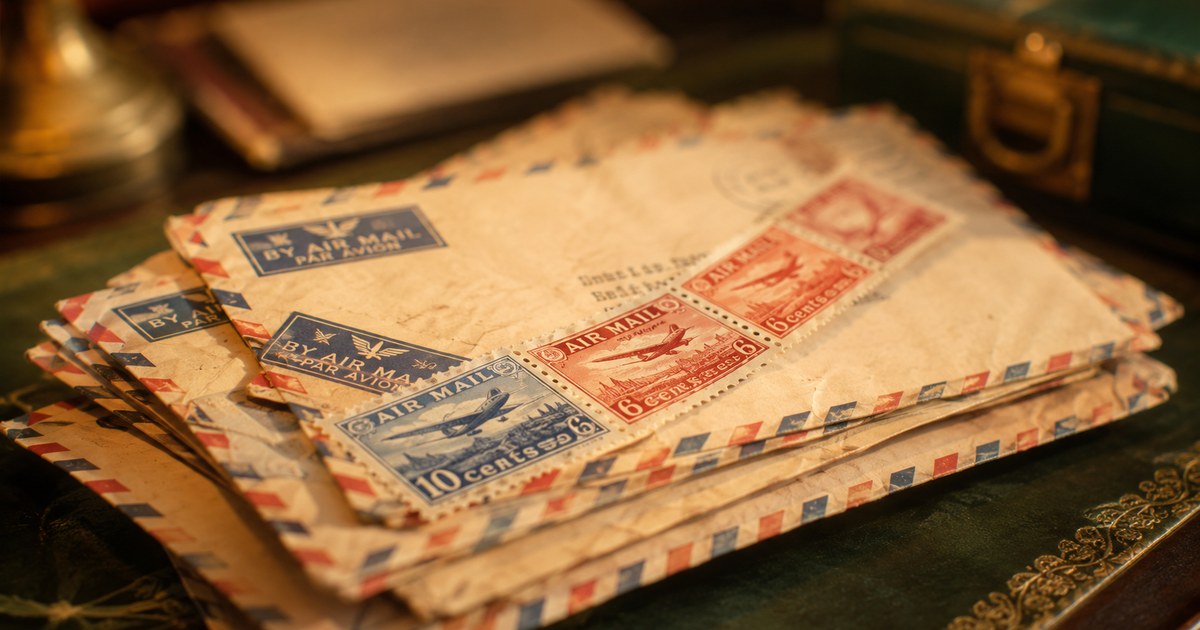
Almost every inherited American album has a page of them: red and blue stamps with aeroplanes, globes and winged envelopes, filed under a heading that says AIR MAIL and numbered C-something in the catalogue. Nearly all of them are worth cents, and the C-number tells you which ones are not.
That is the honest answer to the airmail stamp value question. The Scott C prefix marks these stamps, and the number places them in time: C1 to C24 covers 1918 to 1939 and holds nearly all the value, while C25 onward covers 1941 to 2012 and was printed in quantities running from tens of millions into the billions. Reading the C-number places any US airmail stamp within a decade in seconds.
That last point is the whole trick, and it is why this page is organised as bands rather than as a list. You do not need to identify a stamp to sort it. You need to read one number off the catalogue line and know which side of 1940 you are on.
What does the C prefix on an airmail stamp mean?
Scott catalogues put airmails in a separate sequence from ordinary postage, prefixed with a C, and began assigning that designation to airmail issues in 1940. Collectors call this section the back of the book, because it sits behind the main numbered run rather than inside it. Nothing about the prefix implies rarity or value; it is a filing convention, in the same way that B, E, J and O prefixes mark semi-postal, special delivery, postage due and official issues.
What the prefix does give you is a clean, monotonic timeline. C-numbers were assigned broadly in issue order, so the number itself is a date estimate. Within the 1918 set there is one famous exception worth knowing: Scott numbered those three stamps by denomination rather than by release date, so C3 (24 cents) actually came first, on 13 May 1918, followed by C2 (16 cents) in July and C1 (6 cents) in December.
Airmail stamp value by C-number band
| Band | Years | What is in it | Typical value |
|---|---|---|---|
| C1–C11 | 1918–1928 | Curtiss Jenny biplanes, De Havilland mail planes, the Lindbergh issue | Highest band: the 1918 set alone is $385.00 |
| C12–C24 | 1930–1939 | Winged Globes, the Graf Zeppelins, the Baby Zeppelin | Low, apart from the Zeppelins: C19 is $4.75 |
| C25–C31 | 1941–1944 | Twin-Motored Transport Plane series | Lowest band at the common end (C25 is $0.35), but the 50c C31 is $18.50 |
| C32–C45 | 1946–1949 | Postwar DC-4 Skymasters and commemoratives | Comparable to the band above |
| C46–C132 | 1952–1999 | Jet silhouettes, eagles, event issues | Comparable to the band above: C51 is $0.45 |
| C133–C150 | 1999–2012 | Scenic American Landscapes | Around the face value printed on them |
Every figure in that column is a Mystic Stamp Company dealer-retail asking price, which is what a large dealer asks rather than what any dealer would pay you.
Read the table as a shape rather than a price list. Value falls off a cliff at C25 and never really recovers, and the reason is printing quantity, which is the mechanism behind almost every honest valuation in this hobby. Our guide to what makes a stamp valuable sets out why survivor counts beat age every time.
Why are the common airmails worth so little?
Because they were printed for use, in quantities that are difficult to picture. The 6-cent Twin-Motored Transport Plane of 1941, Scott C25, was issued in a quantity of 4,746,527,700 according to Mystic Stamp Company, which lists it from $0.35 (dealer retail). That is not a misprint: nearly five billion of one stamp. The 7-cent jet silhouette of 1958, Scott C51, ran to 50,483,977 and Mystic lists it from $0.45 (dealer retail).
Those two stamps between them account for a large share of the airmail pages in ordinary American albums, and the picture repeats through the whole postwar run: the 1962 8-cent airliner and Capitol dome, the 1950s eagles, the jet-over-city designs of the 1960s and 1970s. They were bought at the post office window by the sheet, used on ordinary mail, and saved by everybody. The arithmetic is identical to the one behind the three-cent stamp value question, which is the single most common disappointment in American philately.
The 1930s are slightly better without being exciting. The Winged Globe design ran across several values, and the best known of them, the 6-cent dull orange of 1934 (Scott C19), had a quantity of 30,205,100 and is listed by Mystic Stamp Company at $4.75, reduced from $5.75 (dealer retail). A few dollars, not a windfall, and used copies sit below that.
Which airmail stamps genuinely are worth money?
Three groups, and they are easy to isolate because they all live below C25.
The 1918 Curtiss Jennies (C1, C2, C3). America’s first airmail stamps, all three carrying the same Curtiss JN-4 biplane design. Mystic Stamp Company prices a complete set of the three at $385.00 (dealer retail), and condition moves that figure hard in both directions. If your album has a page of 1918 airmails, that page deserves individual attention rather than a sample.
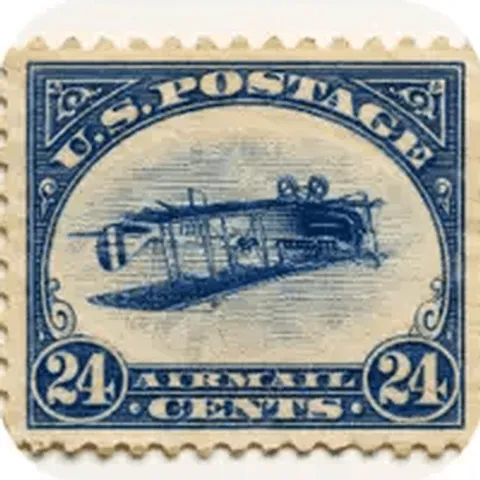
The 24-cent invert, C3a. A single sheet of 100 of the two-colour 24-cent stamp was printed with the central aeroplane upside down, producing the Inverted Jenny. Every one of the hundred is individually tracked, they sit at the absolute top of the United States market, and no second sheet has ever surfaced. Two practical notes follow from that. A genuine example arrives with a documented position and provenance chain, never with a family story. And the design has been reproduced many times, including officially by the Postal Service as a $2 souvenir stamp in 2013, so a denomination other than 24 cents settles the question instantly.
The 1930 Graf Zeppelins (C13, C14, C15). The genuine exception in the middle band, and the one most likely to be sitting unrecognised in an inherited album. Roughly 93 percent of the printing was destroyed unsold in the depths of the Depression, and Mystic Stamp Company lists a complete set of three at $1,775.00 (dealer retail). The denominations to look for are 65 cents, $1.30 and $2.60, and the full story sits in our Graf Zeppelin stamps guide, which also explains why the 1933 Baby Zeppelin (C18) is a much cheaper stamp with a similar picture.
What about airmail covers and later issues?
Two footnotes that change the answer for some readers.
First, envelopes. Airmail was a service before it was a collecting category, and the envelopes that actually flew, especially first-flight covers with route cachets and early transatlantic and transpacific mail, are collected as postal history in their own right. A common stamp on a genuinely interesting cover can be worth several times the soaked-off stamp, which is the standing reason never to soak anything off an old envelope.
Second, the end of the story. Domestic airmail became obsolete around 1975, when the Postal Service began sending first-class mail by air as a matter of routine, so every airmail stamp issued after that point paid an international rate rather than a premium domestic one. The sequence finishes at C150, the $1.05 Scenic America issue of January 2012; when the $1.10 Global Forever stamp appeared in January 2013 it carried no aviation imagery and was given an ordinary catalogue number instead. If your airmails are all landscapes, they are the last chapter, and they are worth roughly what is printed on them.
Sorting your airmail page in five minutes
Pull the page out and split it once, at C25. Everything numbered C25 and above goes into the common pile, with three things pulled back out of it: any denomination of 50 cents or more, since the 50-cent C31 had a print run of only 11,160,600 and Mystic lists it at $18.50 (dealer retail) while its 6-cent stablemate C25 lists at $0.35; anything still in an intact plate block or strip; and anything still on its cover. Everything below C25 gets looked at individually, with particular attention to any denomination in dollars rather than cents, since that is the tell for the Zeppelins. Where those stamps sit in the wider American market is mapped in our United States stamp values guide.
The honest expectation for a typical album page of airmails is a few dollars for the whole page, with a small chance that one pre-1940 stamp is worth more than everything else combined. That is a genuinely good position to be in, because it means five minutes of sorting settles the question. Photograph anything from the below-C25 pile and Stampo will give you the catalogue number and an honest condition-tiered range, which is exactly the point at which guessing stops.
The genuine article
So you can compare against the real thing — these are genuine, public-domain reference images, not illustrations:
Sources
- 1918 Curtiss Jenny airmail stamps - Wikipedia
- List of United States airmail stamps - Wikipedia
- C1-3 - 1918 Curtiss Jenny, Set of 3 Stamps - Mystic Stamp Company
- C19 - 1934 6c Winged Globe, Dull Orange - Mystic Stamp Company
- C25 - 1941 6c Twin-Motored Transport Plane, Carmine - Mystic Stamp Company
- C51 - 1958 7c Jet Airliner, Blue - Mystic Stamp Company
- C13-15 - 1930 Graf Zeppelins, Complete Set of 3 Stamps - Mystic Stamp Company
- 1930 Graf Zeppelin stamps - Wikipedia
- Inverted Jenny - Wikipedia
- C31 - 1941 50c Twin-Motored Transport Plane, Orange - Mystic Stamp Company