Every famous stamp has a story, and the Treskilling Yellow has the best one: a schoolboy, a grandmother’s attic, a dealer who paid pocket money for it, and a price tag that has set world records three times since. The story is told everywhere. What the retellings skip is the question that brings most people to it, which is whether the yellow Swedish stamp in their own album could possibly be the same thing.
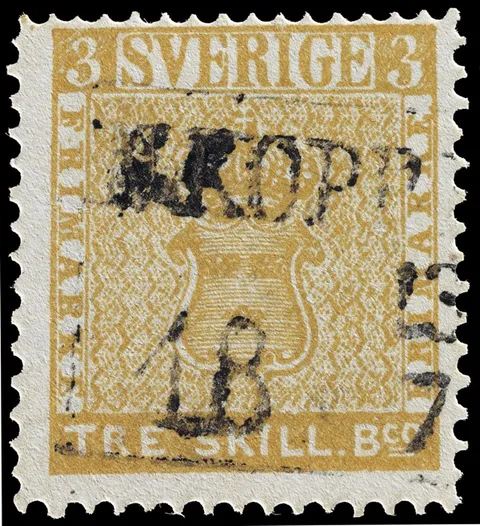
The Treskilling Yellow is a Swedish three skilling banco stamp from 1855 printed by mistake in the yellow-orange reserved for the eight skilling. Only one example has ever been found, in the 1880s, and it last sold at public auction in 1996 for 2.88 million Swiss francs. A yellow Swedish stamp in your album is almost certainly the ordinary eight skilling.
That last sentence is the one we care about, so this article tells the story properly and then turns it around to the stamp in your hand.
Sweden’s first stamps, and the one that went wrong
Sweden issued its first postage stamps on 1 July 1855: a set of five values denominated in skilling banco, each showing the national coat of arms. The three skilling was printed in blue-green and the eight skilling in yellowish orange, with the other three values in their own colours.
The accepted explanation for the error, as Wikipedia summarises it, is mechanical. The plates were built from individual stereotype clichés, one per stamp position. At some point a damaged cliché in the eight skilling plate was replaced, and the replacement was a three skilling cliché. From then on, every sheet printed from that plate in yellow-orange contained one three skilling stamp in the wrong colour. How many sheets went through before anyone noticed is unknown. What is known is that only one of those stamps has ever surfaced.
The currency changed in 1858 and the skilling banco stamps gave way to a new öre series of the same design, as Wikipedia’s history of Swedish stamps records, so the window in which the error could be posted was only a few years long.
The attic, the schoolboy and the seven kronor
In 1886 (some accounts say 1885), a young collector named Georg Wilhelm Backman was going through old letters in his grandmother’s attic near Västerås and found a three skilling stamp in the wrong colour. The stamp carries a Nya Kopparberget cancellation dated 13 July 1857, which is how we know it was genuinely used on mail two years after the issue.
Backman sold it to a Stockholm dealer. Coin World gives the price as 7 kronor; Wikipedia records that a dealer was offering seven kronor per three skilling stamp at the time, which tells you the stamp was bought as an ordinary early Swedish stamp with an odd shade, not as a rarity.
From there the stamp followed the path most of the great rarities took. Wikipedia’s provenance chain runs through the Vienna dealer Sigmund Friedl, who sold it in 1894 for 4,000 florins to Philipp von Ferrary, the greatest collector of the age; then to Claes A. Tamm in 1926 for £1,500; then in 1937 to King Carol II of Romania for £5,000. The Inverted Jenny and the British Guiana one cent magenta passed through some of the same hands; see the Inverted Jenny and British Guiana one cent magenta pages, and our round-up of the rarest stamps in the world.
Was it real? The 1970s argument
A stamp this valuable attracts doubt, and in the 1970s the doubt came from the most serious possible source. The Swedish Postal Museum questioned whether the stamp was genuine at all, suggesting it might be a doctored eight skilling or an outright forgery. The owner disagreed. Two separate expert commissions examined the stamp, one assembled by the museum and one by the seller, and both concluded it was genuine, as Coin World and Wikipedia both record.
The episode matters for anyone who reads this and starts looking at their own stamps. At this level of value, authenticity is decided by committee, with reference material and laboratory examination, not by a colour comparison at the kitchen table. Forgers have worked on the Swedish skilling banco issues for a century; the forgery reference site Stamp Forgeries of the World documents Sperati forgeries of the 3 and 24 skilling values and a Peter Winter reproduction of the yellow error itself, among others. A second genuine Treskilling Yellow would be the philatelic news of the decade, and it would be announced by an expert committee, not by a seller.
What has the Treskilling Yellow sold for?
The record figures, labelled by kind of sale, because the public and private sales are not the same kind of number.
- 1984, public auction: 977,500 Swiss francs at David Feldman in Geneva, a world record for any stamp at the time.
- 1990, private sale: reported at over 1,000,000 US dollars.
- 1996, public auction: 2,880,000 Swiss francs, about 2.3 million US dollars at the time, again at Feldman and again a record. This is the last publicly disclosed price.
- May 2010, closed sale: sold through David Feldman in Geneva to a group of buyers who asked for anonymity, as the Associated Press reported. The price was not disclosed; Feldman stated it was at least the 1996 record. Treat this as a floor, not a figure.
- 2013, private sale: to the Swedish count Gustaf Douglas. Price undisclosed, and no later sale has been made public.
Three things follow. The stamp’s “value” is a single object’s sale history, not a market price, because there is nothing else to compare it with. The best known figure, 2.88 million Swiss francs, is now three decades old. And the stamp has not been offered at open auction since 1996, so a headline that calls it the most valuable stamp in the world is quoting a thirty-year-old result rather than a recent one; we keep its record up to date on the Treskilling Yellow value page.
The yellow Swedish stamp it gets mistaken for
Now the turn. If you are reading this because a yellow Swedish stamp of this design is on your desk, here is what it is far more likely to be than the error.
It is an eight skilling banco. This is the overwhelming case. The eight skilling was legitimately printed in yellow-orange, the exact colour that makes the error famous, and it was the higher-value workhorse of the issue. Read the value line under the arms: the common stamp reads ÅTTA SKILL. Bco. (åtta is Swedish for eight); the unique error reads TRE SKILL. Bco. If yours appears to say ÅTTA, you most likely have the ordinary stamp, and whether it is an 1855 original, a reprint or a forgery, and what condition it is in, decide what it is worth. Jay Smith & Associates, a specialist Scandinavian dealer, lists a used eight skilling with expert certificate at $925 (dealer retail) and a mint example without gum at $4,200 (dealer retail), prices that depend heavily on centring, perforations and certification. Ordinary copies with faults sell for much less, but a genuine 1855 eight skilling is not a stamp to throw in the packet box.
It is a three skilling that has changed colour. The normal three skilling is blue-green, and a green ink that has faded in sunlight or been chemically altered can drift toward yellow. A TRE SKILL. stamp that looks yellowish is far more likely to be a discoloured green than a second example of the error. The 1970s museum argument was, in part, about exactly this possibility.
It is an official reprint. Sweden reprinted the 1855 skilling banco stamps for collectors, in 1868, 1872 and 1885, according to the reprint literature cited by Stamp Forgeries of the World. The 1885 reprints are perforated 13 rather than the original 14, which is a measurable difference; the 1868 reprints are harder to separate and need reference material. Reprints are collectible in their own right and are worth far less than originals.
It is a forgery or facsimile. The skilling banco issues have been forged by Sperati and others, and facsimiles of the famous error have been printed as souvenirs for more than a century. A convincing-looking yellow TRE SKILL. stamp with no provenance should be assumed to be one of these.
It is a later öre stamp. The 1858 öre series kept the coat of arms design in a slightly smaller format, and one value, the 24 öre, is orange. These are common and inexpensive, and the inscription reads ÖRE rather than SKILL. Bco.
This is the same honest arithmetic we apply to the other great rarities. All one hundred Inverted Jennies are accounted for, as we set out in how many Inverted Jenny stamps exist, and the Treskilling Yellow is a census of one with a documented owner. The catalogue price of a unique stamp tells you nothing about what the common stamp beside it is worth, a gap we explore in catalogue value vs what dealers actually pay.
What to do with a yellow skilling banco stamp
Photograph it rather than handle it, because an 1855 stamp in any condition is old enough to deserve care. Stampo will read the inscription and denomination and tell you whether you are looking at an eight skilling, a three skilling, an öre issue or a later design, and give a condition-tiered range for the common stamp you most likely have. If the reading comes back as a three skilling in yellow, do nothing to the stamp, do not clean or soak it, and send clear photographs to a recognised expert committee. It will not be the error; the census is one, and it is accounted for. But the ordinary 1855 stamp beside it in the album deserves a proper identification, and that is the useful outcome of the exercise.
The genuine article
So you can compare against the real thing — these are genuine, public-domain reference images, not illustrations:
Sources
- Treskilling Yellow - Wikipedia
- Sweden's first issue of stamps includes famous color error - Coin World
- Auctioneer claims record price in sale of rare stamp, the Swedish 'Treskilling Yellow' - Fox News / AP (2010)
- Postage stamps and postal history of Sweden - Wikipedia
- Sweden Specialized Stamps: 1855 Skilling Banco - Jay Smith & Associates
- Forged stamps of Sweden - Stamp Forgeries of the World